TL;DR:
- Overlooked safety practices cause most roofing accidents, failures, and insurance issues.
- Texas’s hazardous weather conditions and high fall fatalities emphasize the need for strict safety protocols.
- Hiring contractors with proper certifications, inspections, and safety plans ensures quality and long-lasting roofs.
Most roofing accidents, denied insurance claims, and premature roof failures share one root cause: overlooked safety practices. Texas homeowners face some of the most hazardous roofing conditions in the country, from hail-battered shingles to storm-soaked slopes that turn a repair job into a serious fall risk. Falls account for 82% of roofing fatalities, with 134 roofer deaths recorded in 2023 alone. What most homeowners don’t realize is that safety isn’t just the crew’s problem. It affects your installation quality, your insurance coverage, and ultimately how long your roof lasts. This guide gives you the knowledge to demand better from every contractor you hire.
Table of Contents
- Why roofing safety is critical in Texas
- Key safety standards and best practices
- Inspections, certifications, and Texas-specific requirements
- How safety impacts quality and your investment
- Why real roofing safety goes beyond compliance
- Protect your home with qualified, safety-first roofing
- Frequently asked questions
Key Takeaways
| Point | Details |
|---|---|
| Safety saves lives | Rigorous safety in roofing work prevents accidents and protects everyone involved. |
| Texas law matters | Roof replacements in many counties require special inspections and certifications for insurance. |
| Quality links to safety | Jobsites that prioritize safety lead to higher-quality roofs and fewer callbacks. |
| Demand documentation | Homeowners should always ask for written safety plans and certifications before work begins. |
Why roofing safety is critical in Texas
Texas weather is relentless. Hailstorms, high winds, and sudden downpours create roofing conditions that are far more dangerous than in most other states. After a major storm, crews are often rushed, roofs are wet, and debris is everywhere. That combination is a recipe for accidents.
The numbers back this up. Texas recorded 41 roofer fall deaths in a single recent year, and falls remain the single biggest killer in the trade, accounting for 82% of all roofing fatalities nationwide. These aren’t abstract statistics. They represent real workers on real Texas rooftops, often in your neighborhood.
“A contractor who cuts corners on safety is cutting corners on your roof. The two go hand in hand.”
For homeowners, the risks go beyond the crew’s wellbeing. If a worker is injured on your property and your contractor lacks proper insurance, you could face serious liability. Many homeowners don’t know that an uninsured contractor’s injury can become your legal and financial problem.
Here’s what’s at stake when safety is ignored:
- Worker injuries that delay your project and expose you to liability
- Rushed installations that lead to leaks, poor flashing, and ventilation failures
- Insurance complications when work doesn’t meet code or safety standards
- Voided warranties if installation isn’t done by certified, compliant crews
Understanding the Texas storm repair workflow helps you see where safety checkpoints belong in the process. And getting regular roof inspections before and after storm season gives you a clear picture of what your roof actually needs. Safety starts before the first shingle is lifted.
Now that you know safety risks are real and close to home, let’s define what professional roofing safety actually looks like.
Key safety standards and best practices
The roofing industry has clear rules. The problem is that not every contractor follows them, and most homeowners don’t know what to ask for. Understanding the basics puts you in a much stronger position.
OSHA requires fall protection for any roofing work at six feet or higher. That means guardrails, personal fall arrest systems, or safety nets must be in place. Despite this, fall protection remains the single most cited OSHA violation year after year. In 2025 alone, there were 5,914 fall protection violations recorded across the industry.
Steep slopes, summer heat, and wet surfaces all require stricter protocols. A crew working a 6:12 pitch in July Texas heat faces very different risks than one working a flat commercial roof in mild weather. Your contractor should adjust their safety plan accordingly.
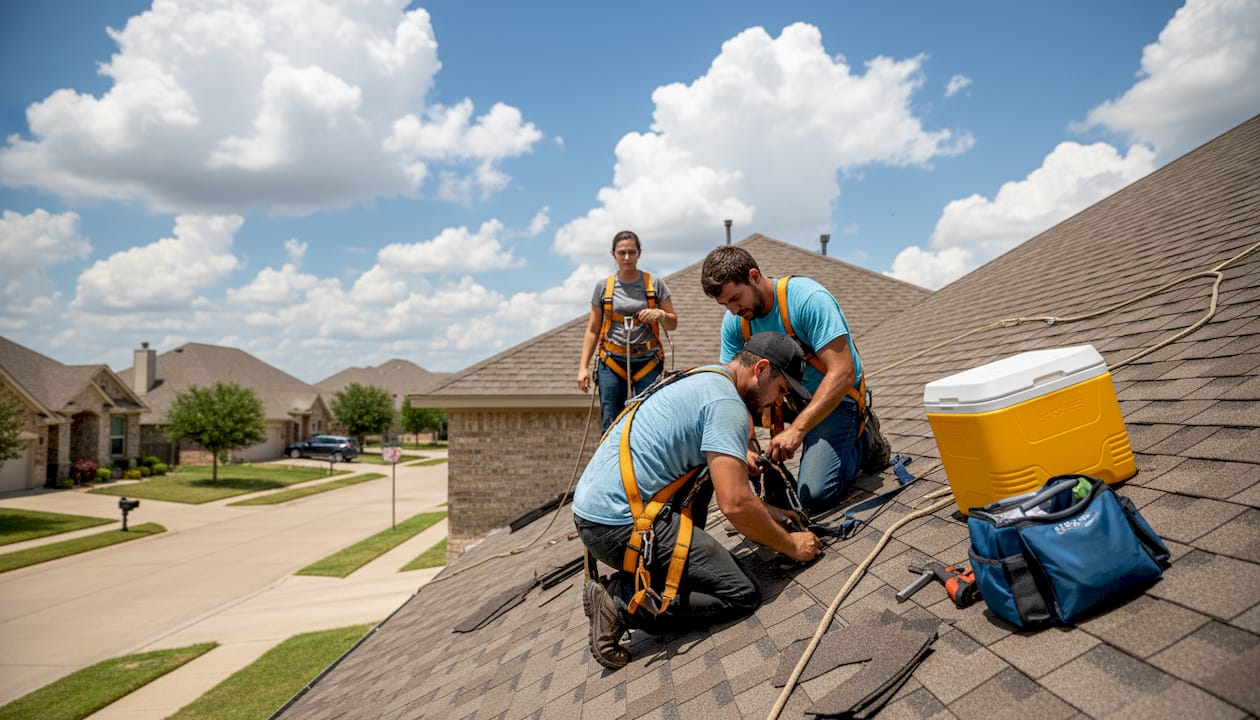
Common fall protection systems explained:
| System | Best for | Key requirement |
|---|---|---|
| Personal fall arrest | Steep slopes | Full-body harness, anchor point |
| Guardrail systems | Low-slope roofs | 42-inch height minimum |
| Safety nets | Large commercial jobs | Installed below work area |
| Warning line systems | Flat roofs only | 6 feet from roof edge |
Beyond equipment, certifications matter. Look for contractors with STEP (Safety Training and Evaluation Process) certification or RCAT (Roofing Contractors Association of Texas) membership. These signal a contractor who has invested in safety training, not just a business card.
Pro Tip: Before signing any contract, ask your roofer for their written fall protection plan and a daily safety checklist. A legitimate contractor will have both ready to share without hesitation.
Here’s a quick checklist of what to request before work starts:
- Proof of general liability and workers’ compensation insurance
- Written fall protection plan specific to your roof
- OSHA compliance documentation
- STEP or RCAT certification
- Daily safety inspection records
Learning how to find a reliable roofing contractor in Texas means knowing these questions by heart. You can also review Texas roofing codes to understand what’s legally required in your area.
Understanding the standards is one thing. Seeing how they’re enforced and why they matter in practice is another.
Inspections, certifications, and Texas-specific requirements
Texas has roofing rules that go beyond what most other states require, and if you live near the coast, they directly affect your insurance coverage.
Texas windstorm inspections are required for roof replacements in 14 coastal counties. After the work is done, a licensed inspector must verify the installation and issue a WPI-8 certificate through the Texas Department of Insurance. Without it, your windstorm insurance claim could be denied, even if the damage is clearly storm-related.
Here’s what a thorough post-installation inspection covers:
| Inspection area | What’s checked | Why it matters |
|---|---|---|
| Flashing | Sealing at edges, valleys, and penetrations | Prevents water intrusion |
| Ventilation | Intake and exhaust balance | Extends shingle life |
| Shingle installation | Nail pattern, overlap, alignment | Affects wind resistance |
| Site cleanup | Debris, nails, material disposal | Safety and property protection |
A thorough inspection doesn’t just protect your insurance. It can double your roof’s effective lifespan by catching installation errors early, before they become expensive leaks or structural damage. Skipping the inspection to save time is one of the costliest mistakes Texas homeowners make.
Here’s how to make sure your contractor follows through:
- Ask upfront whether your county requires a TDI windstorm inspection
- Confirm the inspector is TDI-licensed before work begins
- Request the WPI-8 certificate as a condition of final payment
- Keep copies of all inspection records with your homeowner’s insurance documents
Reviewing the full Texas storm repair checklist helps you track every step from damage assessment to final sign-off. If hail was involved, following a structured hail damage inspection process ensures nothing gets missed before the crew even starts.
Beyond paperwork, proactive safety programs show real, measurable value for homeowners and crews.
How safety impacts quality and your investment
Here’s something the roofing industry doesn’t advertise enough: safety and quality are the same thing in disguise. When a crew is rushing, skipping harnesses, and ignoring protocols, they’re also skipping the careful steps that make a roof last.
Safe jobsites reduce incidents by up to 85% and are directly linked to longer roof lifespans. That’s not a coincidence. A crew that takes time to set up proper fall protection is also the crew that takes time to nail shingles correctly, seal flashing properly, and leave your property clean.
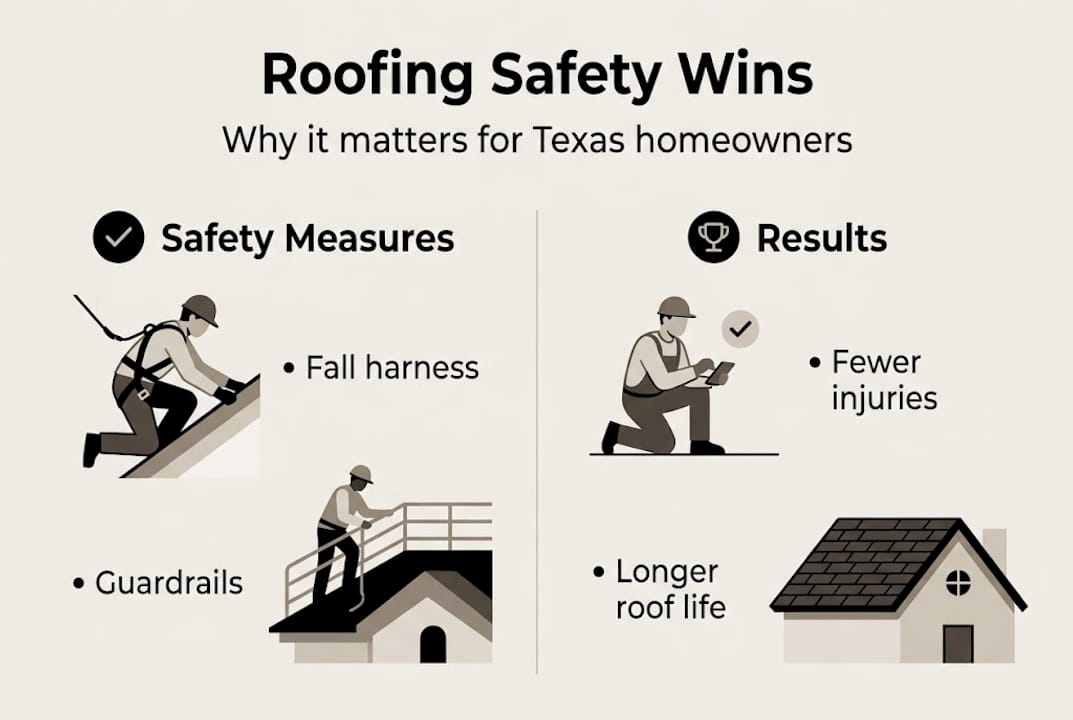
Contractors who follow OSHA best practices and structured safety programs cut incident rates by 59 to 60% compared to those who don’t. That same discipline shows up in every nail pattern and every sealed valley.
A rushed, unsafe project almost always requires costly callbacks. Improper ventilation causes shingles to fail early. Missed flashing leads to water damage inside your walls. These aren’t minor issues. They’re multi-thousand-dollar repairs that a safety-focused installation would have prevented.
Pro Tip: Ask your contractor for their Total Recordable Incident Rate (TRIR). This is a standard industry metric that measures how often workers get hurt. A low TRIR is a strong signal that the crew operates with discipline and care on every job.
Here’s what a safety-focused installation actually delivers for you:
- Fewer leaks because flashing is installed carefully, not quickly
- Better ventilation because the crew isn’t rushing the ridge cap
- Longer warranty validity because installation meets manufacturer specs
- Cleaner worksite because safety culture includes site organization
- Lower long-term costs because callbacks and repairs drop significantly
Understanding why roof maintenance matters for Texas homeowners helps you see that safety during installation is just the first step in protecting your investment for the long haul.
Why real roofing safety goes beyond compliance
We’ve seen it firsthand: a contractor shows up with the right paperwork, checks every OSHA box, and still cuts corners the moment the inspector leaves. That’s the difference between compliance and culture.
Most roofing crews will tell you safety is a priority. But watch how they behave when a job is running behind schedule. That’s when you see whether safety is genuinely valued or just treated as red tape. A crew that truly prioritizes safety slows down when conditions get risky. They don’t push through wet roofs to meet a deadline.
As a homeowner, your biggest leverage is asking the right questions before the contract is signed. Ask how they handle weather delays. Ask what happens if conditions become unsafe mid-job. A contractor who gives you a straight, confident answer has thought about it. One who gets defensive hasn’t.
Your roof is one of the most expensive components of your home. It deserves a crew that treats safety as proof of professionalism, not a hurdle to clear. When you’re choosing a reliable roofer, look for this attitude. It tells you more about quality than any sales pitch ever will.
Protect your home with qualified, safety-first roofing
Knowing what to demand from a roofing contractor is only half the equation. The other half is finding a team that already operates that way without being asked.
At Mister ReRoof, safety and quality aren’t separate checklists. They’re built into every project we take on across Texas. Whether you need a metal roof replacement in Victoria or a shingle roof replacement in Hallettsville, our crews follow strict safety protocols and meet all Texas certification requirements. We handle the inspections, the documentation, and the workmanship so you don’t have to worry. Contact Mister ReRoof today for a free estimate and see what a safety-first roofing team actually looks like on the job.
Frequently asked questions
What is the most common roofing accident in Texas?
Falls are the leading cause of roofing injuries and deaths in Texas, accounting for 82% of all roofing fatalities statewide.
What safety certification should my Texas roofer have?
Look for OSHA compliance, STEP certification, and RCAT licensing as baseline indicators that a contractor takes safety seriously.
Do I need an inspection after a roof replacement in Texas?
Yes. Homeowners in certain Texas counties need a TDI WPI-8 windstorm inspection after roof replacement to maintain valid windstorm insurance coverage.
How does safety affect roof quality?
Proper safety protocols lead to more careful, precise installations. Safe jobsites double roof lifespan by reducing rushed work and installation errors that cause early failures.