TL;DR:
- Built-up roofing in Texas lasts 25 to 35 years with proper maintenance.
- BUR provides superior hail impact resistance due to multiple layers and gravel surface.
- Regular inspections and gravel maintenance are essential for maximizing BUR lifespan.
Most flat roof owners in Texas have heard of built-up roofing, but few realize it regularly outlasts competing systems by a decade or more. BUR, short for built-up roofing, uses alternating layers of bitumen and reinforcing fabric topped with gravel, creating a roof that excels against hail, wind, and heat in ways that single-ply membranes simply cannot match. Yet many homeowners dismiss it as old-fashioned or assume it costs too much. This guide breaks down exactly how BUR works, what it costs, how it performs under Texas conditions, and what you need to know before making your next roofing decision.
Table of Contents
- What is built-up roofing? Fundamentals and history
- How built-up roofing stands up to Texas weather
- Pros and cons of built-up roofing for Texas homes
- Factors to consider before installing built-up roofing
- Best practices for maintaining a built-up roof in Texas
- A Texas roofing pro’s perspective: When BUR is the right call
- Need expert advice or a quote for your flat roof?
- Frequently asked questions
Key Takeaways
| Point | Details |
|---|---|
| Unmatched Texas durability | Built-up roofing is one of the most storm- and hail-resistant options for flat roofs in the Texas climate. |
| Balance of benefits and trade-offs | BUR lasts for decades and protects flat roofs but is heavier and more costly to install than single-ply options. |
| Maintenance maximizes lifespan | Annual checks and gravel upkeep are essential to reach the roof’s 25+ year potential and warranty terms. |
| Not always the best fit | BUR excels in high-wear, hail-prone uses but may not be suitable for energy-saving priorities or buildings with weak structure. |
What is built-up roofing? Fundamentals and history
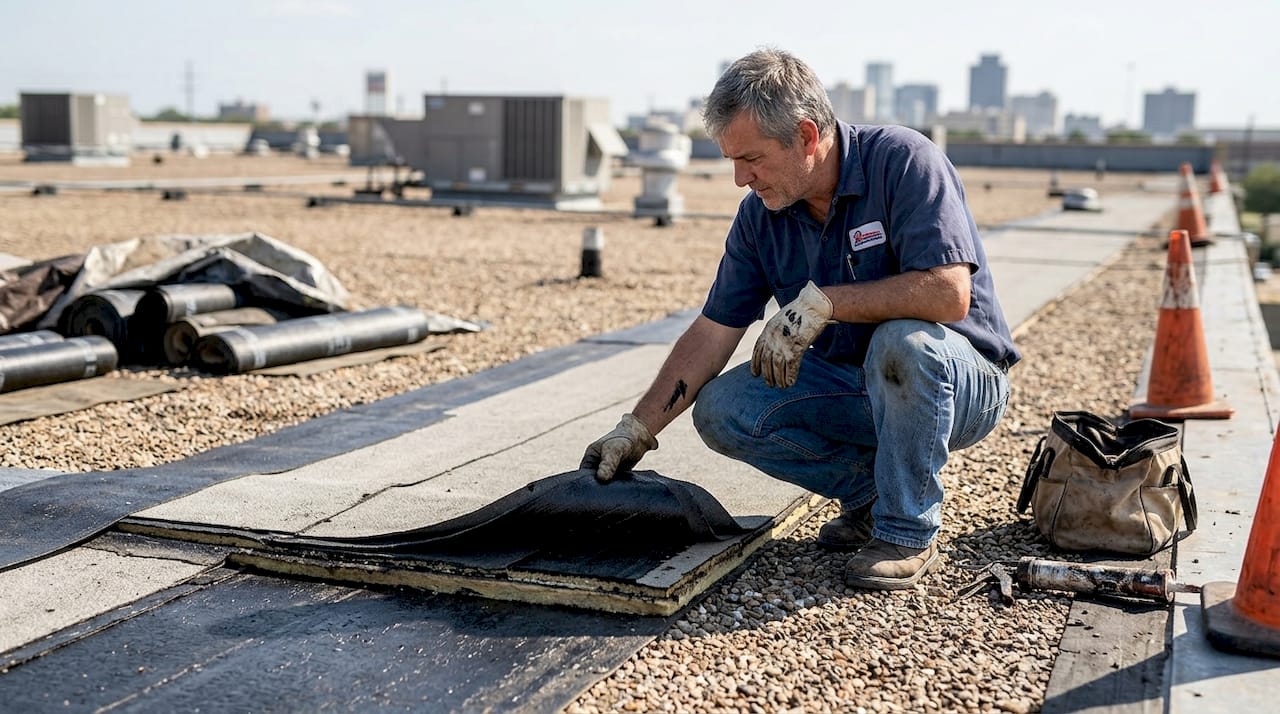
Built-up roofing gets its name from the way it is constructed: layer by layer, built up on site. Installers alternate between sheets of reinforcing felt or fiberglass fabric and hot-applied or cold-applied bitumen, which is a tar-like waterproofing material. Once the layers are in place, a top coat of gravel or a cap sheet is applied to protect everything underneath. The result is a thick, seamless membrane that covers the entire roof deck.
BUR has been around for well over 100 years, making it the original flat roof solution in America. It became the standard for commercial and industrial buildings throughout the 20th century before single-ply options like TPO and EPDM arrived. That long track record is not just history. It is proof that the system works.
Here is what a standard BUR system includes:
- Base sheet: The first layer, bonded directly to the roof deck
- Bitumen layers: Hot asphalt or coal tar applied between each ply
- Reinforcing plies: Felt or fiberglass sheets that add strength and waterproofing
- Surfacing layer: Gravel, slag, or a mineral cap sheet on top
“BUR systems typically last 20 to 30 or more years with proper maintenance, and in Texas conditions, lifespans of up to 35 years are not uncommon.”
For anyone planning a BUR installation, understanding these layers upfront helps you ask the right questions and set realistic expectations for your project.
How built-up roofing stands up to Texas weather
Texas weather does not give roofs a break. You get brutal summer heat pushing past 100°F, sudden hailstorms that can drop golf ball-sized ice, and wind gusts that test every seam and edge. BUR handles all three better than most alternatives.
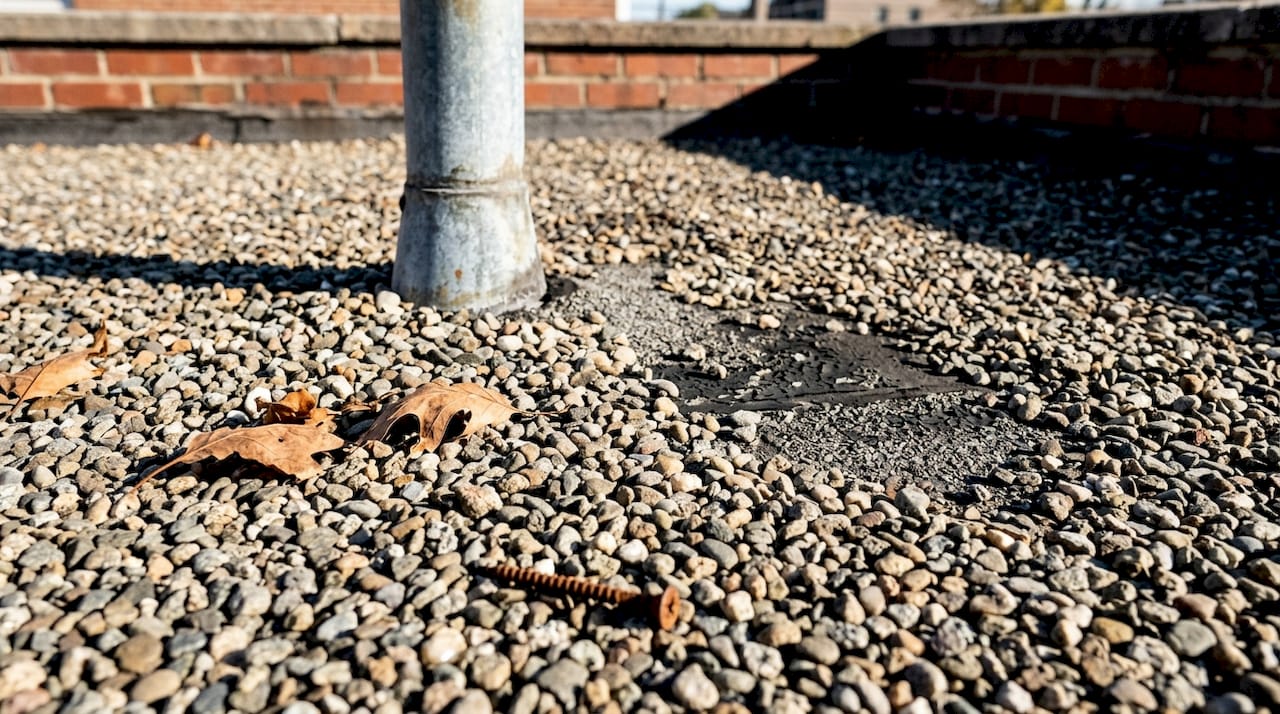
The gravel surface layer is the first line of defense. It reflects some UV radiation, absorbs hail impact, and adds significant weight that resists wind uplift. Gravel provides wind uplift resistance and hail buffering, and BUR carries a Class A fire rating, the highest available. That fire rating matters in Texas, where dry conditions can make fire spread quickly.
When it comes to hail specifically, the multi-layer design is what sets BUR apart. BUR provides more impact resistance than single-ply roofs in hail-prone areas because each layer absorbs energy before it can reach the deck below.
| Feature | Built-up roofing | Single-ply (TPO/EPDM) |
|---|---|---|
| Hail resistance | Excellent | Moderate |
| Wind uplift resistance | High (gravel weight) | Moderate to high |
| Fire rating | Class A | Class A (varies) |
| UV protection | Good (gravel) | Good (white membrane) |
| Puncture resistance | Superior | Moderate |
| Lifespan | 25 to 35 years | 15 to 25 years |
Pro Tip: Do not let gravel scatter or thin out over time. Bare spots expose the bitumen directly to UV rays, which accelerates cracking and shortens your roof’s life significantly. Redistribute or replenish gravel every few years as part of your regular maintenance.
For a broader look at how BUR stacks up against other options, flat roof solutions compared gives you a side-by-side breakdown worth reviewing.
Pros and cons of built-up roofing for Texas homes
No roofing system is perfect for every situation. BUR has real strengths, but it also comes with trade-offs you need to understand before committing.
The benefits:
- Longevity: A well-maintained BUR can last 25 to 35 years in Texas, outlasting most single-ply alternatives
- Storm resistance: Multiple layers and gravel surfacing absorb hail and resist wind uplift
- Fire protection: Class A fire rating provides the highest level of fire resistance available
- Puncture resistance: Thick layers make it far harder to puncture than a single membrane
- Redundancy: If one layer is compromised, the others continue protecting the building
The drawbacks:
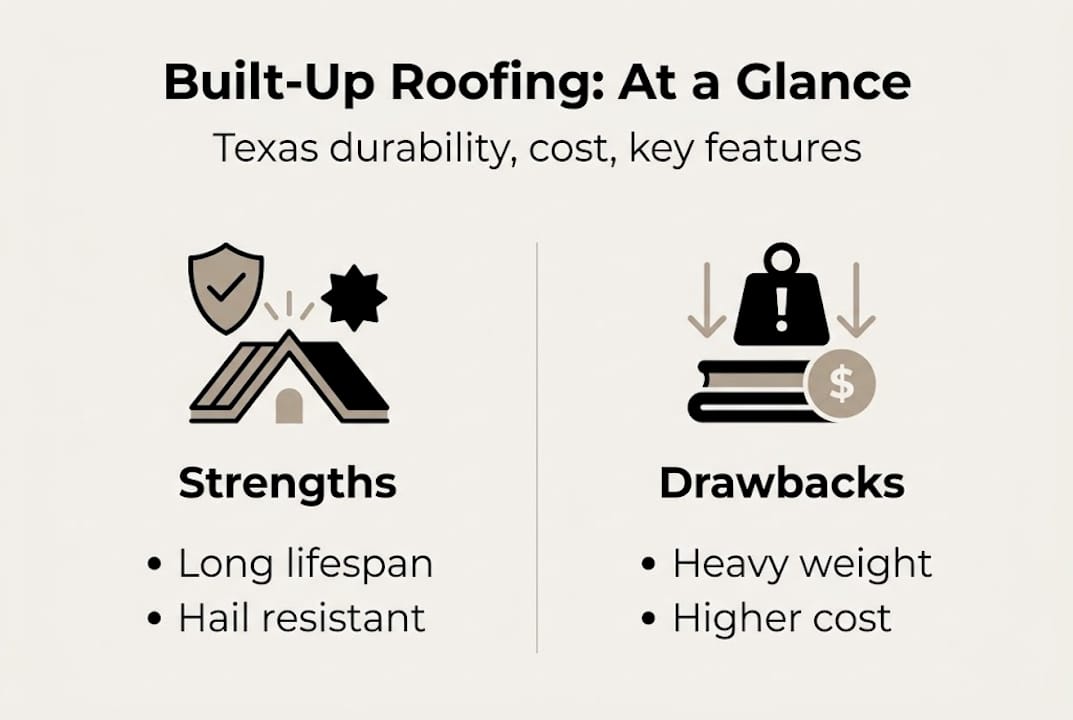
- Heavy weight: BUR weighs 6 to 8 pounds per square foot, which is significantly heavier than single-ply systems and may not suit all structures
- Complex installation: Hot asphalt application is messy, requires skilled crews, and takes longer than membrane systems
- Leak detection: When a BUR leaks, finding the exact source can be difficult because water travels between layers before showing up inside
- Higher upfront cost: More materials and labor mean a bigger initial investment compared to TPO or EPDM
Stat callout: At 6 to 8 lbs per square foot, BUR is one of the heaviest flat roof systems available. Always have a structural engineer or experienced contractor verify your building can handle the load before installation begins.
BUR fits best on buildings with foot traffic (rooftop equipment access), properties in hail-heavy areas, and structures with solid decking. If your building has structural concerns or energy savings are your top priority, review your roof replacement options and check out BUR maintenance requirements before deciding.
Factors to consider before installing built-up roofing
BUR is a long-term investment. Getting it right from the start saves you from expensive repairs or premature replacement down the road. Here is what to check before moving forward.
- Structural load capacity: Confirm your building can support 6 to 8 lbs per square foot. Older homes or light-frame structures may need reinforcement.
- Drainage design: Ensure proper drainage before installation. Ponding water is BUR’s biggest enemy and can void warranties.
- Installer experience: Hot asphalt application requires trained crews. Ask contractors how many BUR projects they have completed in Texas specifically.
- Weather timing: Avoid installation during rain or extreme cold. Bitumen needs the right temperature to bond correctly.
- Local building codes: Some Texas municipalities have specific requirements for flat roof systems, especially in flood-prone areas.
- Energy efficiency add-ons: If reducing cooling costs matters to you, plan for a reflective coating from the start.
| Checklist item | Texas-specific note |
|---|---|
| Structural support | Heat and storms add stress; verify load rating |
| Drainage slope | Minimum 1/4 inch per foot to prevent ponding |
| Installer credentials | Ask for Texas references and hot-asphalt experience |
| Reflective coating | Highly recommended given intense summer UV |
| Gravel depth | Maintain 3/4 inch minimum for UV and hail protection |
Pro Tip: Ask your contractor about reflective roof coatings applied over BUR. They will not turn BUR into a cool roof overnight, but they meaningfully cut heat gain in Texas summers. Explore energy-efficient roofing options, energy-saving upgrades, and cool roofing choices to see what pairs well with BUR.
Best practices for maintaining a built-up roof in Texas
Once your BUR is installed, the work is not over. Consistent maintenance is what separates a 20-year roof from a 35-year roof. The good news: BUR maintenance is straightforward once you know what to look for.
Key maintenance tasks:
- Check gravel depth twice a year: Thin or bare spots expose bitumen to UV damage. Rake gravel back into place or add new material as needed.
- Clear all roof drains and scuppers: Clogged drains cause ponding water, which is the number one cause of BUR failure in Texas.
- Inspect flashings around penetrations: HVAC units, vents, and skylights are common leak entry points. Check caulk and metal flashings after every major storm.
- Look for blistering or bubbling: These are signs of trapped moisture or heat damage. Catch them early before they spread.
- Repair cracks promptly: Small cracks in the bitumen surface can be patched quickly and cheaply. Ignored, they become major leaks.
Warranties on BUR systems can last up to 20 years, and routine maintenance pushes real-world lifespans to 25 to 35 years in Texas conditions. That math makes annual inspections one of the highest-return investments you can make in your property.
Pro Tip: Schedule a professional roof inspection every spring and again after any storm that drops hail or brings winds above 50 mph. Catching a small issue in April is far cheaper than discovering a major leak in August.
A Texas roofing pro’s perspective: When BUR is the right call
Here is the honest take after working on flat roofs across Texas for years: BUR gets unfairly dismissed because people focus on the installation mess and the upfront cost, and they forget what they are actually buying.
What you are buying is redundancy. Every layer is an insurance policy. When a hailstorm hits and punches through the gravel and the first ply, the second and third plies are still doing their job. That is not something a single-ply membrane can offer.
“The gravel and multiple layers of a BUR system act like a built-in insurance policy. One layer fails, and the building stays dry. That kind of redundancy is rare in modern roofing.”
BUR is ideal for high-traffic or hail-prone roofs but is not always the best fit for maximum energy savings or weaker structures. If your building sits in a hail corridor, has rooftop equipment that workers access regularly, or needs a roof that can take a beating without constant repairs, BUR is the answer. If your structure is light-frame or energy savings are your primary goal, look at the energy trade-offs with BUR before committing. The right roof is the one that matches your building, your budget, and your Texas reality.
Need expert advice or a quote for your flat roof?
If you have made it this far, you already know more about built-up roofing than most property owners in Texas. Now it is time to put that knowledge to work on your actual building.

At Mister ReRoof, we specialize in flat roof replacement for homeowners and property managers across El Campo and Houston. Whether you are weighing BUR against TPO, need a structural assessment before installation, or want a straightforward quote, our team has the hands-on Texas experience to guide you. Visit Mister ReRoof to schedule your free estimate today and get a roofing solution built to handle whatever Texas throws at it.
Frequently asked questions
How long does built-up roofing last in Texas?
With proper maintenance, BUR in Texas routinely lasts 25 to 35 years, and manufacturer warranties can cover up to 20 years of that lifespan.
Is built-up roofing good for hail-prone areas?
Yes. BUR with gravel offers superior impact resistance in hail-prone Texas areas, absorbing energy across multiple layers rather than relying on a single membrane.
What are the main drawbacks of built-up roofing?
BUR is heavy at 6 to 8 lbs per square foot, involves a messier and more expensive installation than single-ply systems, and makes locating leaks more difficult once they develop.
How often should a built-up roof be inspected?
Routine annual inspection and a post-storm check after significant weather events will keep your gravel, drains, and flashings in shape and extend BUR’s lifespan considerably.
Can built-up roofing help with energy efficiency?
BUR alone is not the most energy-efficient flat roof option, but adding a reflective coating can significantly reduce heat gain and cut cooling costs in Texas summers.