TL;DR:
- Roofing codes in Texas are mandatory regulations based on local adaptations of the IRC to withstand regional storms.
- Non-compliance with roofing codes can void warranties, lead to denied insurance claims, and result in legal penalties.
- Staying compliant involves obtaining proper permits, hiring knowledgeable contractors, and keeping up with evolving local regulations.
A single overlooked code requirement on your roof can void your warranty, trigger a denied insurance claim, or kill a home sale at closing. Many Texas homeowners discover this the hard way, long after the contractor has packed up and left. Non-compliant roofs in Texas can void warranties, delay or deny insurance claims, and even increase your premiums. This guide breaks down exactly what Texas roofing codes require, why they exist, and how staying compliant protects your home, your wallet, and your legal standing from day one.
Table of Contents
- What are roofing codes and who sets them in Texas?
- How roofing codes protect your home from Texas weather
- Legal, insurance, and financial risks of ignoring roofing codes
- Staying compliant: Permits, contractors, and evolving codes
- The hidden value of roofing codes: An expert’s perspective
- Professional help for roofing code compliance in Texas
- Frequently asked questions
Key Takeaways
| Point | Details |
|---|---|
| Texas codes save homes | State and local roofing codes help houses withstand wind and hail common across Texas. |
| Non-compliance costs big | Ignoring codes can lead to denied insurance, legal fines, and expensive repairs after storms. |
| Permits and contractors matter | Get the right permits and use insured, code-savvy contractors to ensure lasting protection and resale value. |
| Code upgrades bring savings | Investing in compliant, impact-resistant roofs can unlock insurance discounts and peace of mind. |
What are roofing codes and who sets them in Texas?
Roofing codes are mandatory regulations that govern the materials, installation methods, and safety standards for any roof built or replaced in Texas. They are not suggestions. They are the legal minimum your roof must meet before a building inspector signs off on the work.
Texas does not have a single statewide roofing code. Instead, Texas roofing codes are based on the International Residential Code, known as the IRC, with local amendments that target regional risks like high winds, hail, and extreme heat. That means the rules in Houston can differ from the rules in Amarillo or San Antonio. Your city or county is the main enforcer.
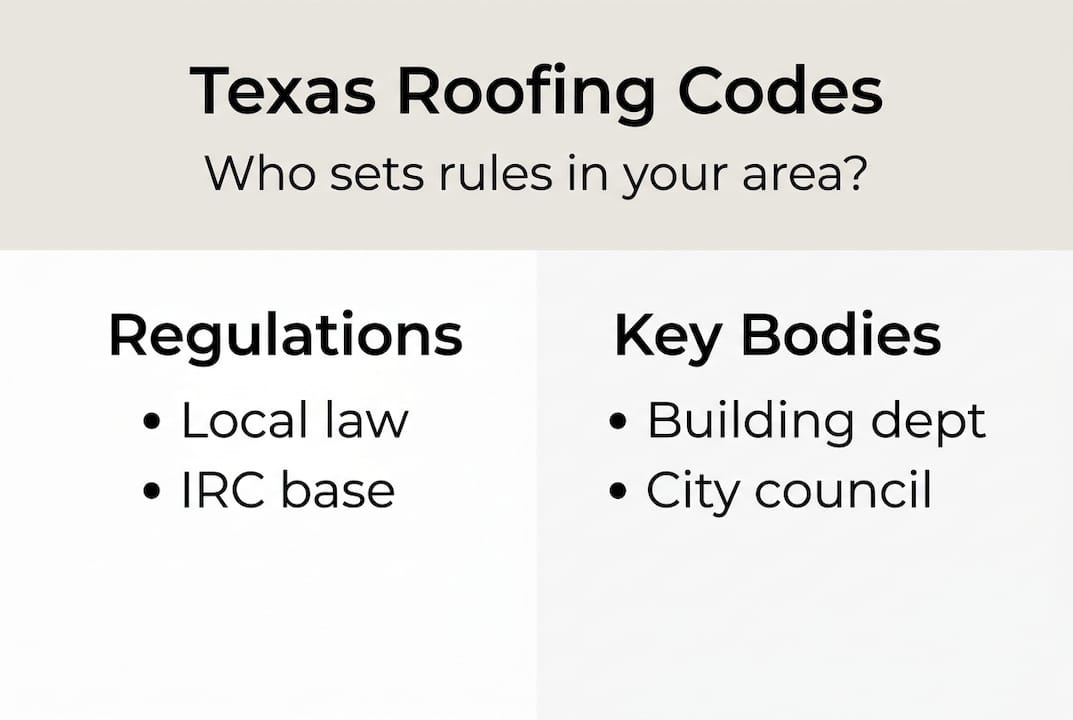
Because there is no statewide contractor licensing requirement for roofers, local permits become even more critical. Your local building department issues the permit, sets the inspection schedule, and ultimately decides whether your new roof passes. If it does not pass, the work must be corrected before the project is legally complete.
The 2024 IRC introduced updated tornado provisions, but here is something most homeowners do not know: 2024 IRC tornado provisions are not adopted for most Texas homes. Local jurisdictions choose which code cycles to follow, so adoption is uneven across the state. That gap matters in a state that leads the nation in tornado frequency.
Understanding Texas roofing basics helps you ask the right questions before any work begins. Here is what roofing codes typically address:
- Wind resistance: Minimum design wind speeds, often 115 mph or higher in coastal and storm-prone areas
- Hail resistance: Material ratings for impact resistance, especially Class 3 and Class 4 shingles
- Underlayment: Type and installation method required beneath shingles or other surface materials
- Fasteners: Number, type, and placement of nails or screws per shingle or panel
- Ventilation: Intake and exhaust ratios to prevent moisture buildup and heat damage
- Decking: Minimum thickness and condition requirements for the structural layer beneath roofing material
| Code area | What it regulates | Why it matters in Texas |
|---|---|---|
| Wind resistance | Design wind speed minimums | Hurricanes and severe storms |
| Hail resistance | Impact rating for materials | Frequent large hail events |
| Underlayment | Type and layering method | Moisture and storm protection |
| Ventilation | Intake and exhaust ratios | Extreme heat and humidity |
| Fasteners | Nail count and placement | Prevents blow-off in high winds |
Knowing this framework is the first step toward making smart decisions when you hire a contractor or plan a roof replacement.
How roofing codes protect your home from Texas weather
Texas weather is not gentle. The state sees more tornadoes than any other in the country, and cities like Amarillo average more than 2 inches of hail per year. These are not rare events. They are the baseline your roof must be built to handle.
Codes respond directly to this reality. Roofing codes require roofs to withstand winds up to 115 mph and hail over 2 inches in diameter in places like Amarillo. In coastal areas near Houston, wind speed requirements climb even higher. These numbers are not arbitrary. They come from decades of storm data and engineering research.
Here is what a compliant versus non-compliant roof looks like when a major storm rolls through:
| Feature | Compliant roof | Non-compliant roof |
|---|---|---|
| Wind uplift resistance | Meets or exceeds 115 mph design | May fail below design threshold |
| Hail damage | Class 4 shingles absorb impact | Standard shingles crack or puncture |
| Underlayment | Properly layered, sealed | Gaps allow water intrusion |
| Fastening | Code-specified nail pattern | Under-nailed, prone to blow-off |
| Insurance outcome | Claim likely approved | Claim often denied or reduced |
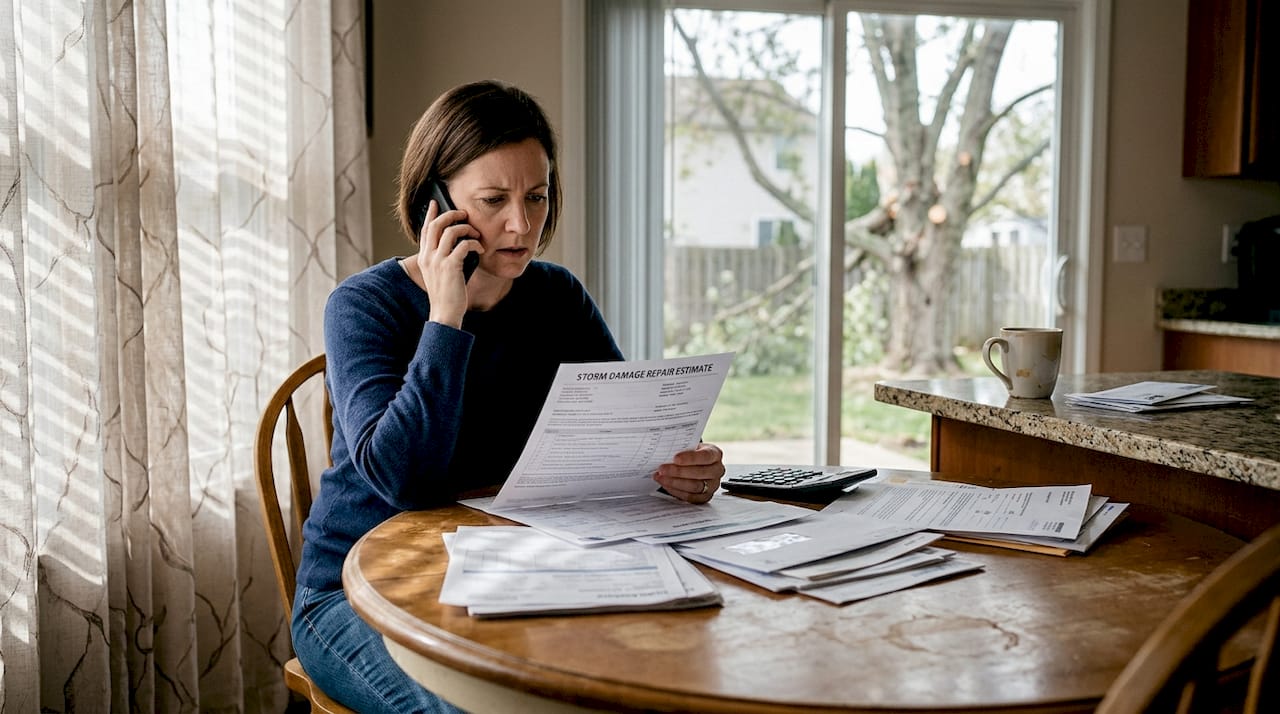
The financial stakes are enormous. Major Texas hail events have caused over $6.8 billion in storm insurance claims. A non-compliant roof puts you on the wrong side of that number. One homeowner in the Houston area discovered $15,000 in hidden water damage after a storm, traced directly to improper underlayment that failed a code standard the contractor had skipped.
Good storm-resistant roofing starts with materials rated for your specific region. Understanding roofing durability in Texas weather helps you see why code minimums exist and where upgrading beyond them pays off.
Pro Tip: Always ask your contractor about Class 4 impact-resistant shingles. They meet or exceed code in most Texas jurisdictions, and many insurers offer meaningful premium discounts of 20 to 30 percent for homes with Class 4 materials installed.
Code-compliant roofs also perform better over time. Proper ventilation prevents heat buildup that degrades shingles prematurely. Correct fastening keeps materials locked down through repeated wind cycles. These are not luxury features. They are the foundation of a roof that actually lasts.
Legal, insurance, and financial risks of ignoring roofing codes
Skipping code compliance is not just a technical mistake. It is a legal and financial risk that can follow you for years.
In Texas, permits are required for roof repair or replacement that covers more than 25% of the roof area, or any work involving structural changes. That threshold is lower than most homeowners expect. A significant storm repair or a full replacement almost always triggers the permit requirement.
What happens when you skip it? The consequences stack up fast:
- Stop-work order: The city can halt construction mid-project until permits are pulled and inspections are scheduled.
- Fines: Unpermitted work can result in monetary penalties from your local building department.
- Mandatory tear-out: In some cases, inspectors require completed work to be removed so they can verify what is underneath.
- Failed resale inspection: Buyers’ inspectors and lenders routinely flag unpermitted roofing work, which can kill a sale or force costly corrections.
- Denied insurance claim: Insurers investigate the installation when you file a storm claim. Non-compliant work gives them grounds to deny or reduce your payout.
The insurance angle deserves special attention. Non-compliant roofs often trigger denied or delayed insurance claims, a pattern that affected 23% of claims in 2021, and they void warranties and raise premiums. That is nearly one in four claims impacted.
“Homeowners with non-compliant roofs paid an average of $4,200 more out of pocket per storm claim compared to those with code-compliant installations, due to partial denials and coverage gaps.”
There is also the issue of ordinance and law coverage. When a storm damages your roof and current codes require upgrades beyond what you had before, standard insurance policies often do not cover those upgrade costs. You need a specific ordinance or law provision added to your policy. Without it, you pay the difference.
Review a roof replacement permit checklist before your project starts so you know exactly what documentation to gather and what inspections to expect.
Staying compliant: Permits, contractors, and evolving codes
Compliance is not complicated, but it does require intentional steps. Here is how to stay on the right side of the rules.
Permits: Pull them before work begins, not after. Your contractor should handle this, but you should confirm it. Ask to see the permit number and verify it with your local building department. After the project is complete, get written documentation of the final inspection approval. Keep that paperwork with your home records.
Choosing the right contractor: There is no statewide roofing license in Texas, which means local permits, codes, and hiring a licensed and insured contractor are essential protections for you. Ask every contractor for proof of liability insurance and workers’ compensation coverage. Ask whether they pull their own permits and whether they are familiar with your local jurisdiction’s current code cycle.
Here is a checklist for vetting a contractor:
- Proof of general liability insurance
- Proof of workers’ compensation coverage
- References from recent local jobs
- Confirmation they will pull the permit
- Written scope of work referencing code-compliant materials
- Agreement to provide final inspection documentation
For detailed guidance on hiring a Texas roofing contractor, look for contractors who can explain the specific code requirements for your area, not just offer a generic pitch.
Keeping up with code updates: Codes change. The 2024 IRC tornado provisions are one example of how upgrades may become necessary for insurance or resale, even if your local jurisdiction has not yet adopted them. Staying informed about roof upgrades and evolving codes keeps you ahead of surprises.
Pro Tip: Ask your insurance agent specifically about ordinance and law provisions. This add-on covers the cost of bringing your roof up to current code after a covered loss, which standard policies often exclude. It is usually inexpensive and can save you thousands.
The hidden value of roofing codes: An expert’s perspective
We hear it often: homeowners see permits and code requirements as red tape that slows down a project and adds cost. We understand that frustration. But after working on roofs across Texas, we have seen what happens when those steps get skipped.
The homes that fare worst after major storms are almost never the ones with the oldest roofs. They are the ones with roofs installed without permits, with materials that cut corners on impact ratings, or with fastening patterns that looked fine from the ground but failed under real wind load.
Insurance claim denials are not random. Adjusters are trained to spot non-compliant work. And when they find it, the homeowner absorbs costs that should have been covered.
Here is the perspective that changes how most people think about this: code-compliant upgrades often pay for themselves. Class 4 shingles cost more upfront, but the insurance discounts and reduced claim risk frequently offset that within a few years. Upgrading for durability and compliance is not just about following rules. It is about building a roof that actually protects you when Texas weather does what Texas weather does.
Think of codes as the floor, not the ceiling. Meeting them is the minimum. Building above them is where real value lives.
Professional help for roofing code compliance in Texas
Understanding the rules is one thing. Having a contractor who knows them inside and out is another.
At Mister ReRoof, we work with homeowners across Texas to make sure every roof replacement meets local code requirements and is backed by proper permits and inspections. Whether you need a metal roof replacement in Victoria, TX or a shingle roof replacement in Hallettsville, our team handles the paperwork, the inspections, and the workmanship. You get a roof that is built right, documented properly, and ready to stand up to whatever Texas throws at it. Contact us today for a free estimate.
Frequently asked questions
What happens if I skip getting a permit for my roof replacement in Texas?
Skipping a permit can lead to fines, stop-work orders, failed resale inspections, and denied insurance claims. Legal non-compliance creates a paper trail problem that follows your home through every future sale or insurance event.
Do roofing codes apply to small roof repairs?
Codes generally apply if repairs cover more than 25% of the roof area or involve structural changes. Smaller cosmetic repairs may not trigger a permit, but it is always worth confirming with your local building department.
Will insurance cover storm damage if my roof doesn’t meet code?
Most insurers can deny or reduce claims for non-code roofs. Claims are often denied or delayed for non-compliant installations, and your premiums may increase even if a claim is partially paid.
How do I keep up with changing roofing codes in Texas?
Check with your local building department and consult a reputable contractor who stays current on code cycles. Codes evolve regularly, and what was acceptable five years ago may now require an upgrade for insurance or resale purposes.