TL;DR:
- Texas homeowners face extreme weather hazards such as hail, high winds, and intense heat, requiring tailored roofing solutions. Impact-resistant Class 4 shingles offer excellent hail protection and insurance discounts, while metal roofs provide maximum longevity and wind resistance for storm-prone areas. Proper installation and local hazard awareness are essential to ensure optimal roof performance and durability in Texas’ diverse climate.
Texas puts your roof through a punishment that few other states can match. Hail the size of golf balls, straight-line winds pushing past 80 mph, and summer temperatures that bake attic spaces past 150°F all hit within the same calendar year. Choosing the wrong roofing material doesn’t just cost you money at replacement time. It costs you every month in higher energy bills, higher insurance premiums, and stress every time a storm rolls across the Gulf Coast. This guide breaks down the top materials for Texas homes, ranks them against the hazards that matter most, and gives you a clear decision path.
Table of Contents
- Key criteria for selecting roofing materials in Texas
- Class 4 impact-resistant shingles: Texas’s value leader
- Standing seam metal: Maximum longevity and wind protection
- Cool-roof materials: Cutting the Texas heat and saving on energy
- Side-by-side comparison: Which roofing solution fits your needs?
- What most guides miss: Why the real “best” roof depends on your local hazards
- Upgrade your Texas roof for real performance
- Frequently asked questions
Key Takeaways
| Point | Details |
|---|---|
| Balance material trade-offs | Choose roofing based on hail, wind, and heat risks unique to your location. |
| Installation matters | Proper installation and accessory systems are crucial for real-world durability. |
| Shingle and metal both strong | Class 4 shingles and standing seam metal offer top protection if installed correctly. |
| Consider energy efficiency | Cool-roof materials reduce heat absorption, lowering your HVAC costs. |
| Expert help delivers ROI | Local specialists can guide your upgrade to maximize performance and savings. |
Key criteria for selecting roofing materials in Texas
Before you compare price tags or curb appeal, you need to understand the forces working against your roof every single day. Texas doesn’t hand you one weather problem. It hands you three, often at the same time.
As roofing experts note, material choice in Texas is primarily a three-way tradeoff: impact resistance for hail, wind-uplift and water-shedding performance for storms, and heat control for HVAC load. The “best” product depends on which hazard dominates your roof’s exposure.
Here’s what drives a smart material selection for Texas homeowners:
- Hail impact resistance: Texas leads the nation in hail claims. Look for materials rated Class 3 or Class 4 under the UL 2218 standard, which is the industry benchmark for impact resistance.
- Wind uplift performance: Coastal areas near Houston face hurricane-force gusts. Even inland in El Campo, severe thunderstorms produce damaging wind speeds that can peel up poorly fastened roofing.
- Heat reflectance: The right material can reflect a significant portion of solar radiation rather than absorbing it, reducing cooling loads and cutting your monthly electricity bill.
- Material longevity: A roof that needs replacing every 15 to 20 years costs more over a lifetime than one rated for 40 to 70 years, even if the upfront price is higher.
- Installation quality: No material performs to its rated spec unless it’s installed correctly. This point gets overlooked constantly.
- Insurance savings potential: Some materials qualify for meaningful premium discounts in Texas, which offsets their higher purchase price over time.
Understanding Texas weather and roof durability is the first step. Once you know which hazards dominate your zip code, matching a material to that exposure becomes much more straightforward. Homeowners who focus on roofing durability and savings together tend to make better long-term investments than those chasing only the lowest bid.
“The ‘best’ roofing material isn’t universal. For a homeowner in hail-prone central Texas, a Class 4 shingle may outperform metal on value. For a Houston coastal property facing consistent wind events, standing seam metal may be the only sensible choice.” — Roofing industry consensus
Class 4 impact-resistant shingles: Texas’s value leader
Having defined the key criteria, let’s explore the leading cost-value option for most Texas homeowners.
Class 4 impact-resistant architectural shingles are widely recognized as the best balance of hail protection and value for most Texas homeowners. They carry the highest UL 2218 rating, meaning they withstood a two-inch steel ball dropped from 20 feet without cracking during standardized testing.
What makes these shingles compelling isn’t just the material rating. It’s the financial ecosystem around them:
- Insurance discounts of 10 to 28%: Texas insurers actively reward Class 4 installations because they reduce claims costs. That discount compounds over the years.
- Upgrade cost offset: The premium over standard shingles is typically $500 to $1,500 for an average home. Many Texas homeowners recover that difference within two to three years of insurance savings alone.
- Longevity advantage: Quality Class 4 architectural shingles carry 30-year to lifetime warranties, compared to 20 to 25 years for standard 3-tab products.
- Widely available: Multiple manufacturers produce Class 4-rated products at competitive price points, giving you real choice.
However, the material rating is only half the story. Impact-resistant roof systems rely not only on the shingle class but also on correct installation, including wind uplift resistance and the full accessory and underlayment system. A Class 4 shingle nailed down wrong, over deteriorated decking, without proper underlayment and flashing, will fail well below its rated performance.
Pro Tip: When getting quotes for Class 4 shingles, ask each contractor specifically what underlayment they’re using, how they handle ridge ventilation, and whether their installation meets the manufacturer’s full accessory requirements. A roofer who stumbles on those questions should raise a flag.
Pairing quality shingles with proven storm-resistant roofing methods is what produces the durability Texas homeowners actually need. Consistent roof maintenance in Texas after installation also protects that investment over the long run.
Standing seam metal: Maximum longevity and wind protection
Metal roofing offers a distinctly different advantage for Texans who need storm resilience above everything else.
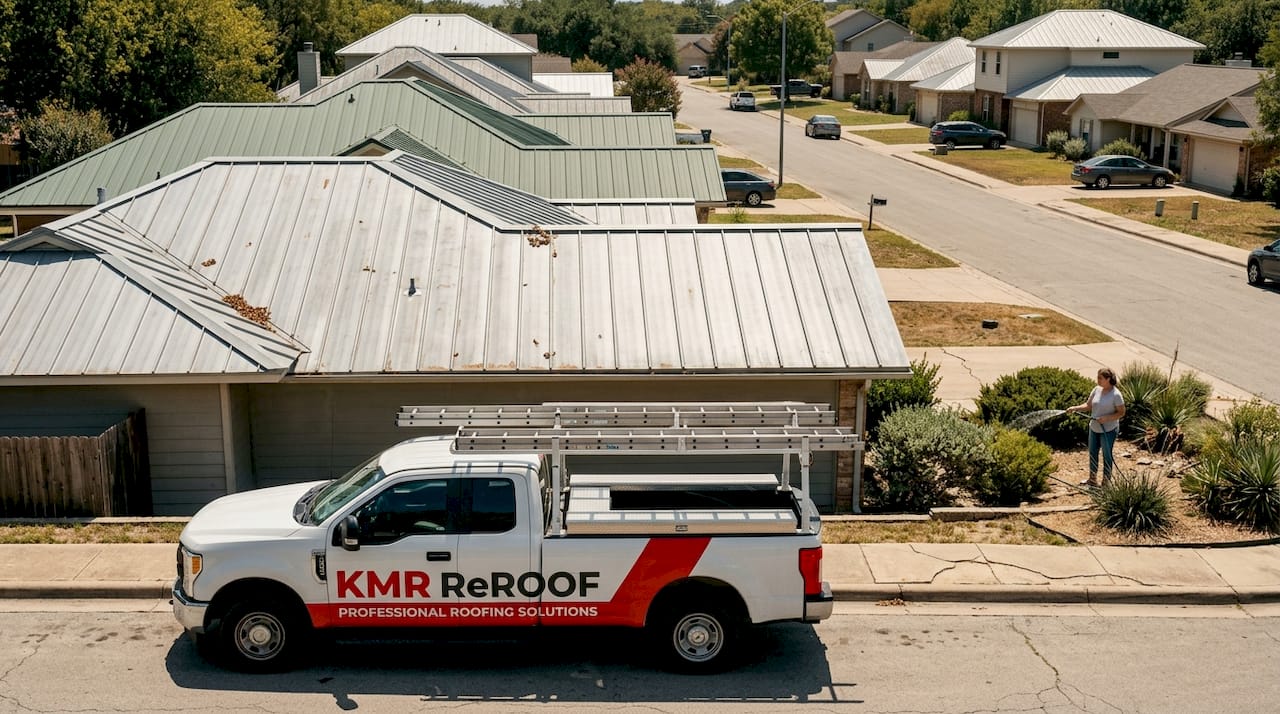
Standing seam metal is a leading choice in Texas for maximum longevity and strong wind resistance, though very large hail can cause cosmetic dents that don’t compromise waterproofing. That distinction matters. A cosmetic dent on metal is not the same as a cracked shingle. The roof keeps working even when it looks less than perfect after a major storm.
Here’s a quick comparison of standing seam metal versus standard shingles:
| Feature | Standing seam metal | Class 4 shingles |
|---|---|---|
| Lifespan | 40 to 70 years | 25 to 50 years |
| Wind resistance | Up to 140+ mph | Up to 130 mph (varies) |
| Hail performance | Cosmetic dents, no leak risk | Rated Class 4, crack risk above 2 in. |
| Heat reflectance | Excellent (light colors) | Moderate to good |
| Upfront cost | High | Moderate |
| Lifetime cost | Low | Moderate |
The economics of metal roofing shift dramatically when you look at total cost of ownership rather than upfront price. If a metal roof lasts 60 years and a shingle roof needs replacement every 25 years, you’re buying roughly two to three shingle roofs for the lifespan of one metal roof. Factor in tear-off costs, installation labor, and inflation, and the metal option often comes out ahead over a 40-year window.
Key advantages of standing seam metal for Texas homes:
- No exposed fasteners: The interlocking panel design eliminates the most common leak points on older screw-down metal systems.
- Thermal expansion allowance: Standing seam panels float slightly on clips, which lets them expand and contract through Texas heat cycles without warping or loosening.
- Fire resistance: Metal is Class A fire-rated, which matters if you’re in a wildfire-adjacent area of Texas.
- Energy performance: A bare steel or aluminum roof in a light color can reflect 60 to 70% of solar radiation, directly reducing cooling loads.
Pro Tip: If upfront cost is a barrier but you want the longevity of metal, check whether your area qualifies for energy efficiency financing or utility rebate programs. Some Texas utilities offer incentives for high-reflectance roofing systems that can reduce your net installation cost.
Pairing metal roofing with smart planning around roof lifespan and savings helps you frame the investment correctly for your household budget.
Cool-roof materials: Cutting the Texas heat and saving on energy
Metal and shingle roofs both compete in the “cool” category. Here’s what actually separates their performance under the Texas sun.
Cool-roof and high solar reflectance materials can meaningfully reduce roof heat absorption in Texas, improving cooling loads for the home below. Two technical terms matter here. Solar reflectance is the percentage of sunlight a roof surface bounces back rather than absorbs. Thermal emittance is how efficiently the roof releases any heat it does absorb. You want both numbers as high as possible in a Texas climate.
| Material type | Solar reflectance | Thermal emittance | Energy savings potential |
|---|---|---|---|
| Light metal (galvalume/white) | 60 to 70% | High | High |
| White or light tile | 50 to 60% | High | High |
| Cool-rated shingles (light tan/gray) | 25 to 40% | Moderate | Moderate |
| Standard dark shingles | 5 to 15% | Moderate | Low |
The performance gap between a dark traditional shingle and a light metal or tile roof is dramatic. On a 100°F Texas afternoon, a dark asphalt roof surface can reach 170°F or more. A high-reflectance metal roof on the same home might stay below 100°F. That difference translates directly into reduced attic heat gain and lower air conditioning demand.
Practical cool-roof choices for Texas homeowners include:
- Light-colored standing seam metal: The top performer across both reflectance and emittance measures.
- Concrete or clay tile in white or light earth tones: Strong reflectance and the natural air gap under tile provides added insulation benefit.
- ENERGY STAR-rated architectural shingles: Available in tan, light gray, and weathered wood tones that qualify for cool-roof ratings without dramatically changing curb appeal.
- TPO membrane (for flat roofs): White TPO is one of the highest-reflectance flat-roof solutions available and is widely used in Houston commercial and residential flat-roof applications.
Pro Tip: Color matters more than material on reflectance. A white asphalt shingle will outperform a dark metal roof for heat reflection. If you’re replacing a dark roof with lighter shingles of the same class, you’ll still see a measurable energy improvement even without switching materials entirely.
Exploring energy-efficient cool roofing options helps you narrow down what’s practical for your roof pitch and budget. For homeowners who want to think longer-term, eco-friendly roofing materials and smart roofing choices offer additional decision frameworks worth reading.
Side-by-side comparison: Which roofing solution fits your needs?
With all major options reviewed, here’s a practical head-to-head summary to support your final decision.
| Material | Hail rating | Wind resistance | Heat performance | Avg. lifespan | Relative cost |
|---|---|---|---|---|---|
| Class 4 architectural shingles | Excellent | Good to very good | Moderate | 30 to 50 years | Moderate |
| Standing seam metal | Good (cosmetic dents) | Excellent | Excellent | 40 to 70 years | High upfront |
| Concrete/clay tile | Good | Good | Very good | 40 to 50 years | High |
| Cool-rated TPO (flat roofs) | Moderate | Good | Excellent | 20 to 30 years | Moderate |
| Standard 3-tab shingles | Poor | Moderate | Poor | 15 to 25 years | Low |
The three-way tradeoff between impact, wind, and heat control is visible clearly in that table. No single material wins every category. Your job is to identify which column matters most for your home’s location and exposure.
Use this decision checklist to guide your choice:
- Identify your primary hazard: Is your area more frequently hit by hail (central and northern Texas), major wind events (coastal Gulf), or extreme sustained heat (west Texas)?
- Set a realistic budget window: Consider total cost over 30 years, not just today’s installation price.
- Confirm insurance savings: Call your insurer before finalizing material selection. Class 4 shingles or metal may qualify you for meaningful premium reductions.
- Verify installer credentials: The material manufacturer’s warranty usually requires certified installation. Ask for proof.
- Check local code requirements: Houston and El Campo may have specific wind-uplift or fire-rating requirements that narrow your choices.
Paying attention to weather impacts on roofing specific to your neighborhood gives you a more accurate picture than any generic state-wide guide.
What most guides miss: Why the real “best” roof depends on your local hazards
Here’s an uncomfortable truth most roofing content won’t say directly: the “top 5 materials for Texas” style list is not really useful on its own. Texas is an enormous, climatically diverse state. What works best in an El Campo neighborhood with frequent hail and moderate wind is genuinely different from what makes sense on a Houston property that faces hurricane season every year.
The deeper issue is that most homeowners make material decisions based on product marketing rather than local hazard mapping. A roofing company sells what it installs most. A national brand promotes its latest product line. Neither of those starting points anchors the choice to your specific exposure.
The second thing guides miss is the installation system. As industry data makes clear, hail and wind outcomes are system outcomes. Even when a material carries a strong Class 4 rating, workmanship details including decking condition, flashing, ventilation, underlayment, and the full accessory package materially influence real-world durability. A Class 4 shingle installed by a careless crew over wet decking with inadequate ventilation will fail years ahead of schedule, regardless of what the product spec sheet says.
What this means practically is that your contractor selection is at least as important as your material selection. Ask potential roofers to walk you through their installation process step by step. Ask specifically about the underlayment product, the ventilation strategy, and how they handle the full accessory system. If they give you a vague answer, find someone who doesn’t. Common roof failure causes in Texas trace back to installation shortcuts far more often than they trace back to the wrong material choice.
The best Texas roof is the right material, installed correctly, by a contractor who understands your local hazard profile. That combination beats any single product recommendation every time.
Upgrade your Texas roof for real performance
Choosing the right material is only the first step. Getting it installed properly, by professionals who know Texas weather and local building requirements, is what turns a good product into a roof that protects your home for decades.
At Mister ReRoof, we specialize in roof replacement services built for the specific demands of El Campo, Houston, and the surrounding Texas communities. Whether you need Class 4 shingle replacement, standing seam metal installation, flat roof TPO replacement, or a cool-roof upgrade, our team delivers workmanship that meets manufacturer specs and stands up to what Texas throws at it. We provide free estimates with no pressure, and we’ll help you match the right system to your home’s actual weather exposure and budget. Contact Mister ReRoof today and get a roof that genuinely performs.
Frequently asked questions
What roofing material lasts longest in Texas?
Standing seam metal offers up to 70 years of lifespan with strong wind resistance, making it the most durable long-term option for Texas homes, though upfront cost is higher than shingles.
How much can Class 4 shingles save on insurance in Texas?
Texas homeowners may save approximately 10 to 28% on insurance premiums after installing Class 4 impact-resistant shingles, which often offsets the upgrade cost within a few years.
Are cool-roof materials really effective in Texas heat?
Yes. High solar reflectance roofing such as light metal or tile can significantly reduce roof surface temperatures, cutting cooling demands and lowering monthly energy bills for Texas homeowners.
Do installation details really affect hail and wind resistance?
Absolutely. Workmanship details like underlayment, flashing, ventilation, and accessory packages have a major impact on real-world roof performance, often more than the material rating alone.