
TL;DR:
- Most Texas roofs deteriorate faster than manufacturer warranties suggest due to extreme heat, UV exposure, and storms. The typical lifespan of asphalt shingles in Texas is 15 to 25 years, substantially less than in cooler climates, and proper maintenance can extend overall roof life. Condition-based assessments and proactive repairs are more effective for longevity than relying solely on age or manufacturer estimates.
Most Texas homeowners assume their roof will last as long as the warranty says. That assumption costs thousands of dollars. Roof life expectancy 2025 and beyond looks very different in Texas than it does in cooler states, because the combination of extreme heat, intense UV radiation, and severe storm activity creates wear patterns that no manufacturer warranty fully accounts for. If you bought a home with a 30-year shingle roof and you’re planning on it lasting 30 years in Houston, you may be in for a surprise well before that deadline.
Table of Contents
- Understanding roof life expectancy by material type
- How Texas climate and wear affect roof longevity
- Common signs it’s time to replace your roof
- Balancing cost, lifespan, and maintenance for roof replacement
- Maximizing roof life through maintenance and repairs
- A fresh perspective on roof life expectancy for Texas homeowners
- Roof replacement solutions for Texas homeowners
- Frequently asked questions
Key Takeaways
| Point | Details |
|---|---|
| Material matters most | Different roofing materials have widely varying life expectancies, especially in Texas climate. |
| Climate accelerates wear | Texas heat and storms shorten roof lifespans largely by damaging asphalt shingles. |
| Watch for early signs | Granule loss, leaks, and broken shingles indicate your roof may need replacement soon. |
| Maintenance extends life | Regular inspections and targeted repairs can add years to your roof’s service life. |
| Cost per year guides choices | Balancing upfront cost, lifespan, and maintenance helps you budget smartly for replacement. |
Understanding roof life expectancy by material type
Not all roofs age at the same rate, and the gap between materials is wider than most homeowners realize. Residential roof service lives range from 15 to 25 years for EPDM rubber roofs all the way up to 60 to 150 years for slate, with metal roofs generally landing between 40 and 80 years and architectural asphalt shingles averaging around 30 years. In Texas, those upper-end estimates shrink.
Asphalt shingles are by far the most common material on Texas homes, and they come in two main types. Three-tab shingles last roughly 20 to 25 years, while architectural shingles (also called dimensional shingles, which have a layered, textured look) are rated for 25 to 30 years. In practice, many Texas roofs made from three-tab shingles show significant wear well before the 20-year mark because of heat and UV exposure.
Metal roofing is a strong long-term investment if you plan to stay in your home. Standing seam metal and steel panel systems routinely last 40 to 70 years with minimal maintenance. The upfront cost is higher, but the cost per year tells a completely different story. Understanding asphalt shingles suitability in Houston helps clarify when asphalt makes sense versus when a metal upgrade pays off faster.
| Roofing material | Typical lifespan | Texas-adjusted estimate |
|---|---|---|
| 3-tab asphalt shingles | 20–25 years | 15–20 years |
| Architectural asphalt shingles | 25–30 years | 20–25 years |
| Metal (steel/aluminum) | 40–70 years | 35–60 years |
| EPDM rubber (flat roofs) | 15–25 years | 15–20 years |
| Slate | 60–150 years | 60–100 years |
| TPO membrane | 20–30 years | 18–25 years |
The Texas-adjusted estimates in the table above are not manufacturer specifications. They reflect the real-world impact of this climate on roof material lifespan.
How Texas climate and wear affect roof longevity
Texas summers routinely push rooftop temperatures above 150°F. At those temperatures, the asphalt binder inside shingles begins to break down faster than in moderate climates. Granule loss, thermal cycling, and UV oxidation are the three main drivers of shortened shingle life in hot climates like ours. Granules are the small stone particles embedded in the top surface of shingles. They protect the asphalt beneath from direct sun. Once they start washing off into your gutters, the clock speeds up on your entire roof.
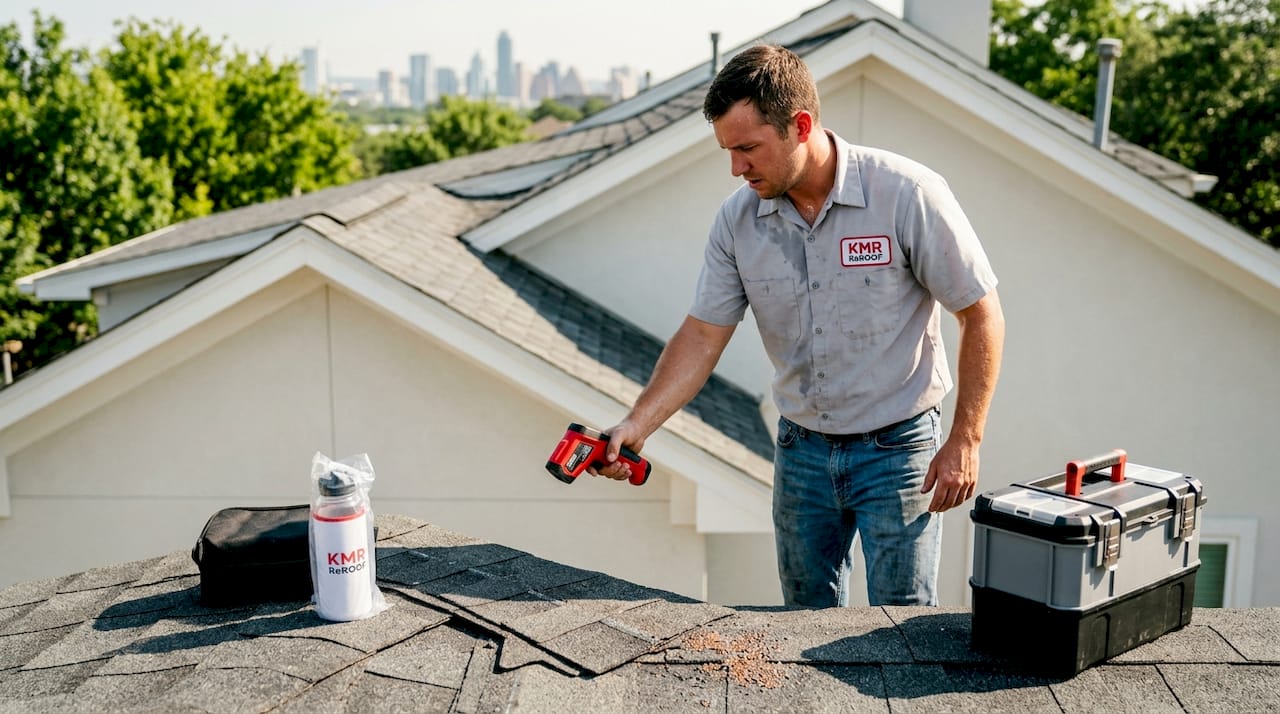
Thermal cycling is the physical stress caused by your roof expanding in the day’s heat and contracting at night when temperatures drop. This happens every single day. Over years, it loosens fasteners, widens existing micro-cracks, and separates flashing (the metal strips that seal roof edges, vents, and chimneys) from the surfaces it’s bonded to.
Texas also sits squarely in hail alley. A single significant hailstorm can strip granules across your entire roof in minutes, essentially aging your shingles by several years in one event. Wind events can lift and break shingles along the edges and ridges, creating entry points for water that are not always immediately visible from the ground.
Key climate-driven wear factors to monitor:
- Granule accumulation in your gutters or downspout splash areas
- Cracked or curling shingles visible from the roofline
- Lifted or separated flashing around chimneys, vents, and skylights
- Physical dents or bruising on shingles after a hailstorm
- Dark streaks or algae growth indicating moisture retention
Staying on top of roof maintenance in Texas is not optional if you want your roof to reach the high end of its estimated lifespan.
Pro Tip: After any hailstorm over 1 inch in diameter, schedule a professional inspection within 60 days. Many insurance claims have strict filing windows, and undetected hail damage accelerates deterioration faster than almost any other wear factor in Texas.
Common signs it’s time to replace your roof
Signs of roof aging do not always announce themselves with an obvious leak. By the time water is dripping into your living room, the damage has often been building for months or years. Catching the early signals is where Texas homeowners can save serious money.
The most common replacement indicators include missing granules, broken or missing shingles, active leaks, discoloration, and increased energy bills. Each one tells a different part of the story.
Watch for these warning signs:
- Granules in gutters or on the ground after rain
- Missing, cracked, or curling shingles on any visible roof section
- Staining or wet spots on interior ceilings
- Moss or dark algae streaks on the roof surface
- Noticeably higher cooling bills without a change in AC usage
- Sagging areas anywhere on the roofline or deck
Here is a simple priority order for evaluating severity:
- Active water intrusion indoors (highest urgency, address within days)
- Missing shingles exposing the roof deck (address within weeks)
- Widespread granule loss across multiple sections (plan replacement within one season)
- Curling or cracking shingles across 25% or more of the surface (budget and schedule replacement)
- Discoloration, moss, or early granule loss in isolated areas (repair and monitor)
Pro Tip: If your roof is over 15 years old and you are selling your home, a pre-listing inspection almost always reveals issues buyers will later negotiate against. Knowing the condition upfront gives you control over the conversation.
Understanding which signs require immediate action versus planned replacement is a skill, and the roof replacement tips for homeowners resource breaks this down in practical detail.
Balancing cost, lifespan, and maintenance for roof replacement
The cheapest roof upfront is rarely the cheapest roof over time. This is the math most homeowners miss when they choose three-tab shingles to save $3,000 today. Typical installed costs run $8,000 to $15,000 for three-tab asphalt and $15,000 to $40,000 or more for metal, but the cost-per-year calculation shifts the picture dramatically.
A $12,000 three-tab roof lasting 18 years in Texas costs roughly $667 per year. A $28,000 metal roof lasting 50 years costs $560 per year, and that does not account for the maintenance savings and the fact that you will likely never replace it again while you own the home. That is a genuinely different ownership experience.
| Material | Installed cost (est.) | Texas lifespan | Cost per year |
|---|---|---|---|
| 3-tab asphalt | $8,000–$15,000 | 15–20 years | $400–$1,000 |
| Architectural shingles | $12,000–$22,000 | 20–25 years | $480–$1,100 |
| Metal roofing | $18,000–$40,000+ | 35–60 years | $300–$1,140 |
| TPO (flat roofs) | $7,000–$14,000 | 18–25 years | $280–$780 |
The ranges overlap, which is why material selection cannot be reduced to a single number. Your roof pitch, home size, local weather exposure, and how long you plan to stay in the home all affect which option delivers the best value.
Pro Tip: When getting replacement bids, ask contractors for their cost-per-year estimate at the material’s realistic Texas lifespan, not the manufacturer’s rated lifespan. That one question separates contractors who understand this climate from those who are just reading a brochure.
Getting help with budgeting roof replacement in Houston can give you a clearer picture of what your specific home and situation should realistically cost.
Maximizing roof life through maintenance and repairs
A roof that is maintained properly does not just last longer. It fails differently. Instead of sudden, costly failures, it gives you visible warning signs with time to plan and budget. That is a fundamentally better ownership experience.
Asphalt shingles are designed as repairable systems, meaning many problems can be addressed by replacing individual shingles or sections rather than tearing off the entire roof. This is important for Texas homeowners who may have isolated storm damage on an otherwise healthy roof.
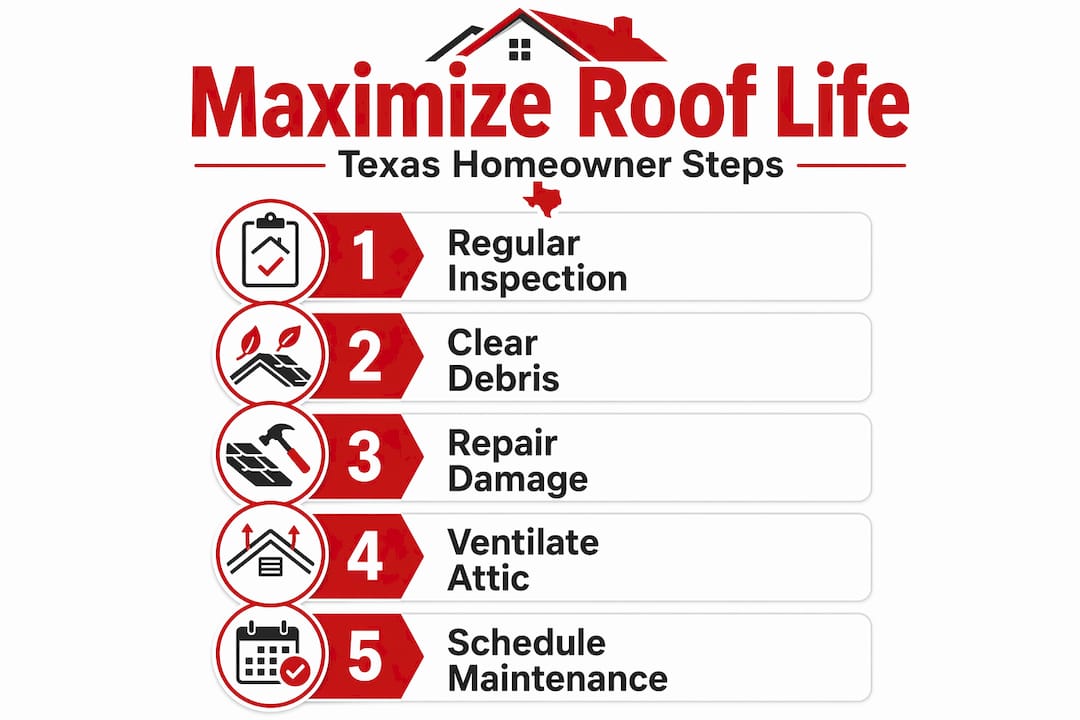
Follow this maintenance routine to protect your investment:
- Inspect twice a year, ideally in spring before storm season and in fall after summer heat stress
- Clear gutters and downspouts after any major storm or leaf fall period
- Replace damaged or missing shingles individually as soon as they are discovered
- Reseal and inspect all flashing around vents, chimneys, and roof edges annually
- Ensure proper attic ventilation, because heat trapped in your attic bakes shingles from below and dramatically shortens their life
- Trim overhanging branches to prevent abrasion and reduce debris accumulation
Attic ventilation is particularly underestimated in Texas. Without adequate airflow, attic temperatures can exceed 160°F in summer, accelerating shingle degradation from underneath at the same time the sun attacks from above. A roofer who ignores attic conditions when replacing your roof is leaving one of the biggest lifespan variables unaddressed.
Learning more about the roof lifecycle and care tips and why regular roof maintenance matters will help you build a maintenance habit that actually protects your investment.
A fresh perspective on roof life expectancy for Texas homeowners
Here is something most roofing articles will not tell you: age is a terrible way to evaluate a roof. We have seen 12-year-old roofs in Houston neighborhoods that needed full replacement because of repeated hail events and poor initial installation. We have also seen 22-year-old roofs in drier parts of Texas that had years of life left after targeted repairs. Age tells you almost nothing by itself.
Remaining roof life is more accurately predicted by condition, specifically granule loss, cracking patterns, and how well the flashing is holding up. In hot climates, flashing failures at chimneys, valleys (where two roof planes meet), and pipe boots almost always show up before the shingle field gives out. If your flashing is leaking but your shingles look reasonable, you do not need a new roof. You need targeted repairs.
The industry standard advice of “replace at 20 years” is written for the national average. Texas is not average. A proactive condition assessment from a qualified local contractor gives you far better information than any age-based rule of thumb.
Contractors can replace damaged shingles and flashings selectively to extend the life of a roof that has years of good service left in it. This approach is cheaper, less disruptive, and often more appropriate than a full replacement triggered by an arbitrary age milestone. Understanding the roof system lifespan in Houston in more detail can help you have a more informed conversation with any contractor you hire.
The right question is not “how old is my roof?” It is “what condition is my roof in, and what does it need to last another 10 years?”
Roof replacement solutions for Texas homeowners
When your roof does reach the end of its serviceable life, working with a contractor who understands the Texas climate makes a measurable difference in how long the next one lasts.

Mister ReRoof specializes in roof replacement across El Campo and Houston, TX, with hands-on expertise in the materials and installation practices that hold up in this climate. Whether you need a metal roof replacement in Victoria TX, a shingle roof replacement in Hallettsville TX, or a TPO roof replacement in El Campo TX, we bring local experience, quality materials, and honest assessments to every job. Contact Mister ReRoof today for a free estimate tailored to your home and budget.
Frequently asked questions
How long does an asphalt shingle roof typically last in Texas?
In Texas, architectural asphalt shingle roofs typically last around 25 to 30 years under ideal conditions, but UV oxidation and thermal cycling in hot climates often reduce that to 20 to 25 years in practice.
What are the earliest signs I should watch for to know my roof needs replacement?
Missing granules, broken shingles, leaks, discoloration, and noticeably higher energy bills are the main early warning signs that your roof may need attention or replacement soon.
Can repairing damaged shingles extend my roof’s life?
Yes. Many repairs can be made without replacing large sections, and targeted fixes to shingles and flashing can halt water intrusion and meaningfully extend overall roof life.
How does Texas weather specifically affect roof longevity?
Texas heat drives rapid granule loss and asphalt deterioration through UV exposure and daily thermal cycling, while hailstorms and high winds increase physical damage risk, often shortening roof life by several years compared to national estimates.