TL;DR:
- Standing water on flat roofs causes costly damage and accelerates membrane degradation, especially in Texas storms. Implementing a structured drainage inspection and maintenance workflow ensures effective water flow, reduces ponding, and protects long-term roof integrity. Regular inspections, debris clearing, slope verification, and secondary overflow checks are essential to prevent costly repairs and extend roof lifespan.
Standing water is one of the most expensive problems a flat roof can develop, and in Texas, it happens faster than most property owners expect. A well-planned flat roof drainage solutions workflow is the difference between a roof that lasts 20 years and one that fails in 10. Poor drainage leads to membrane degradation, structural overloading, and mold growth inside the building envelope. For Texas properties specifically, seasonal storms, airborne debris from surrounding landscapes, and rooftop HVAC equipment compound every drainage weakness. This guide walks you through exactly how to build, execute, and maintain a drainage workflow that keeps your roof protected year-round.
Table of Contents
- Understanding flat roof drainage principles and preparing your site
- Step-by-step workflow to implement flat roof drainage solutions
- Troubleshooting common flat roof drainage problems and mistakes to avoid
- Verifying and monitoring drainage effectiveness for long-term roof health
- Expert perspective: Why a proactive workflow beats reactive fixes for Texas flat roofs
- Professional flat roof drainage solutions and maintenance in Texas
- Frequently asked questions
Key Takeaways
| Point | Details |
|---|---|
| Membrane slope is critical | Flat roofs must have at least 1/4 inch per foot slope using deck or tapered insulation for proper drainage. |
| Regular inspections prevent damage | Schedule bi-annual and post-storm drain inspections to clear debris and avoid ponding and membrane degradation. |
| Secondary drainage is essential | Overflow systems like scuppers provide critical backup when primary drains fail to prevent structural risks. |
| Ponding over 48 hours signals trouble | Water standing more than 48 hours after rain indicates drainage or membrane problems needing remediation. |
| Document and verify drainage health | Use dated photos and digital checklists to monitor and maintain roof drainage effectiveness over time. |
Understanding flat roof drainage principles and preparing your site
Before you touch a single drain or schedule an inspection, you need to understand the core mechanics of how roof drainage works. Flat roofs are not actually flat. They rely on a slight built-in slope to move water toward drains before it has a chance to pool.
The minimum slope standard matters more than most people realize. Per established roof drainage design basics, low-slope roofs require 1/4 inch per foot of positive slope, achieved through either a sloped deck or tapered insulation. Miss that threshold and you are engineering a ponding problem from day one.
There are two drainage tiers every flat roof needs:
- Primary drainage includes internal roof drains, scuppers (openings through parapet walls), and gutters. These handle normal rainfall volume.
- Secondary overflow drainage is the fail-safe. Overflow systems prevent ponding and structural risk when primary drains are blocked or overwhelmed, and building codes require them.
Here is a quick comparison of the most common primary drainage types used on Texas commercial and residential flat roofs:
| Drainage type | Best for | Key advantage | Maintenance demand |
|---|---|---|---|
| Internal roof drains | Large, open roof fields | Handles high volume | Moderate, strainer cleaning required |
| Parapet wall scuppers | Flat roofs with parapet walls | Simple, low cost | Low, but prone to debris blockage |
| Gutters and downspouts | Smaller or residential flat roofs | Easy access for cleaning | High in leafy or debris-heavy areas |
| Tapered insulation slope | Retrofit or new builds | Corrects deck slope deficiencies | One-time install, inspect annually |
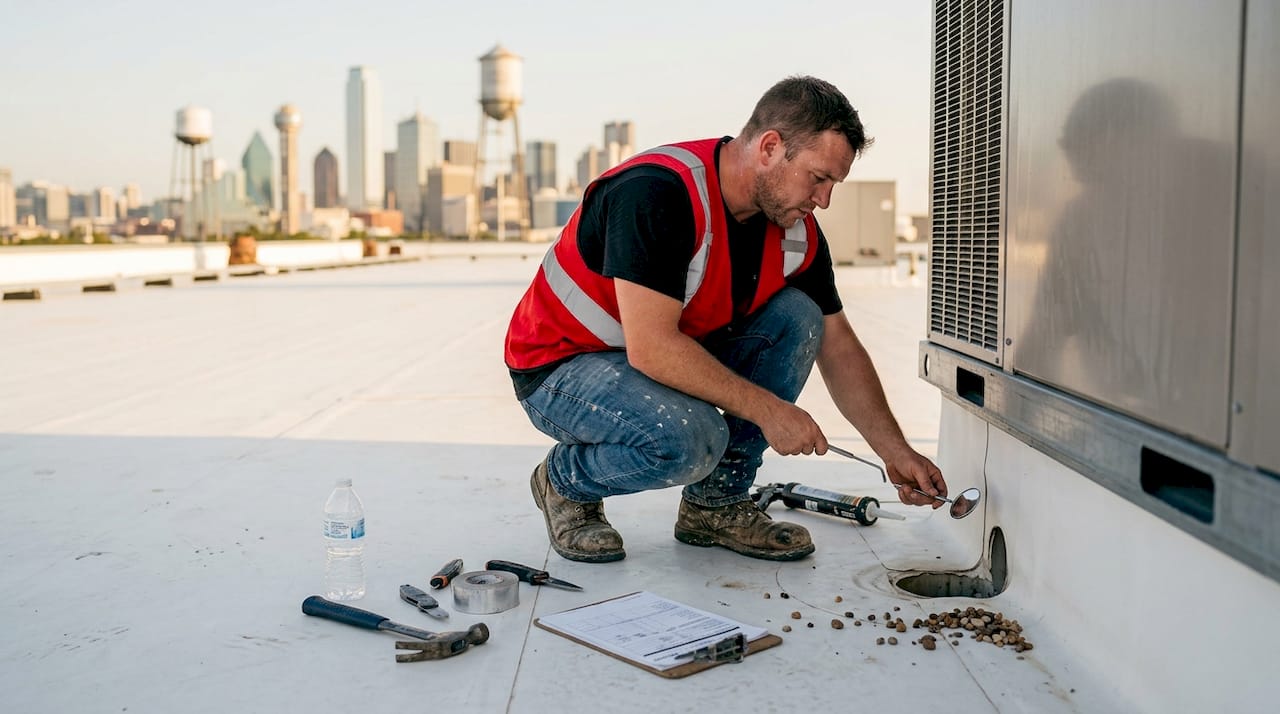
Texas roofs carry unique preparation challenges. HVAC units are often clustered on rooftops, and their platforms can interrupt drainage flow paths. Leaf debris from neighboring trees, bird nests in drain bowls, and biological growth from Houston’s humidity all combine to reduce drainage capacity faster than in drier climates. Before you execute any workflow, walk the roof and map every drain location, every HVAC curb, and every parapet opening.
Now that you understand the core drainage principles and preparatory considerations, let’s move on to a detailed step-by-step workflow for implementing effective flat roof drainage solutions.
Step-by-step workflow to implement flat roof drainage solutions
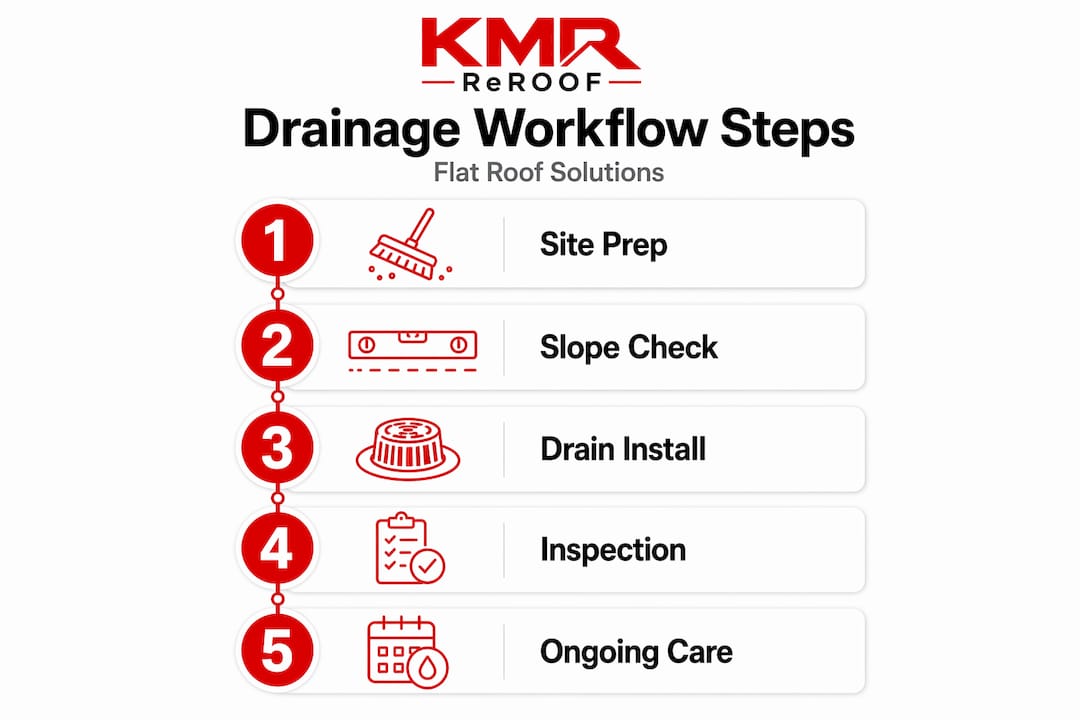
A real flat roof drainage solutions workflow is not a one-time event. It is a repeatable process tied to a calendar and triggered by specific weather events. Here is how to run it correctly.
The full workflow, step by step
-
Schedule inspections at the right intervals. Inspections should happen twice per year, spring and fall, plus within 48 hours after any significant storm. Bi-annual and post-storm inspections focusing on debris clearing and seal integrity are the foundation of preventing ponding.
-
Clear all drain bowls, strainers, and scuppers. Start at every drain and remove debris by hand before using water to flush. Leaving debris in place and just running water through creates blockages further down the drainage line.
-
Verify slope adequacy. Walk the roof after a moderate rain and look for low spots. If water sits in areas away from drains, the slope is insufficient. Tapered insulation installed during a reroof or retrofit corrects slope deficiencies and restores positive drainage.
-
Check secondary overflow scupper elevations. Overflow scuppers must sit higher than primary drains but below the roof membrane termination. If debris is blocking them or they have been inadvertently sealed during prior repairs, clear them immediately.
-
Inspect membrane at drain flashings. Drain flashings are high-failure points. Check for cracks, separations, and standing water around the drain collar. A failed flashing allows water under the membrane before it ever reaches the drain bowl.
-
Document everything with date-stamped photos. Photograph every drain condition, ponding location, and debris accumulation point. This record protects you in insurance claims and tells the story of deterioration over time.
-
Log findings and set a follow-up schedule. Any deficiency found gets a priority tag: immediate fix, next 30 days, or next scheduled maintenance. Do not leave the roof without a written plan.
Pro Tip: Keep a laminated copy of your roof drain map inside the building near the roof access hatch. When you hire a contractor, hand them the map. It cuts inspection time in half and ensures nothing gets missed.
Here is a breakdown of which tasks belong at each inspection interval:
| Task | Spring inspection | Fall inspection | Post-storm check |
|---|---|---|---|
| Clear drain bowls and strainers | Yes | Yes | Yes |
| Clear scuppers and gutters | Yes | Yes | Yes |
| Check membrane at drain collars | Yes | Yes | No |
| Verify slope with water test | Yes | No | Yes |
| Inspect secondary overflow | Yes | Yes | Yes |
| Photo documentation | Yes | Yes | Yes |
With a clear workflow established for installation and maintenance, we now look at how to identify issues and troubleshoot common drainage problems.
Troubleshooting common flat roof drainage problems and mistakes to avoid
Even well-designed flat roof drainage systems develop problems. Knowing what to look for, and what not to do, separates a costly repair from a simple fix.
The most common problems on Texas flat roofs:
- Persistent ponding beyond 48 hours. This signals either a blocked drain, an inadequate slope, or a membrane that has sagged. Clearing debris is always the first step before assuming you need a slope retrofit.
- Biological growth in drain bowls. Houston’s climate grows algae and moss fast. These organisms act like a sponge, holding moisture against the membrane and accelerating degradation. Blocked drains accelerate membrane degradation and create structural overloading risk.
- Bird nests in scupper openings. This is extremely common on parapet walls across central and south Texas. Check scupper openings at every inspection.
- HVAC platform displacement. Equipment platforms shift over time, especially after storms with high winds. A shifted platform can block a drainage flow path entirely.
- Overflow connected to primary drainage piping. This is a critical design error. Secondary overflow must function independently and not tie into primary drainage lines. When primary lines fail or back up, an overflow connected to the same pipe becomes useless.
The most common mistakes property managers make:
- Assuming a drain is clear because water is moving slowly (slow movement often means partial blockage)
- Skipping the post-storm inspection because the roof “looked fine” from ground level
- Patching membrane near a drain without checking whether the drain collar itself is seated correctly
- Waiting until ponding is visible from the parking lot before acting
Pro Tip: After clearing a drain, run a garden hose into it for two full minutes and time how fast the water drains. If it backs up or drains slowly, you have a blockage below the bowl that needs mechanical cleaning, not just surface debris removal.
For situations that go beyond basic clearing, a flat roof repair guide can walk you through escalation steps before you call a contractor.
Once common problems are diagnosed and avoided, verifying your drainage solution’s effectiveness ensures long-term roof health.
Verifying and monitoring drainage effectiveness for long-term roof health
Running a great drainage workflow once is not enough. The goal is consistent performance over the full life of the roof. Verification and monitoring close the loop.
The 48-hour rule is your baseline. Any water remaining on the roof surface 48 hours after rain stops is ponding by definition and requires investigation. This is not a gray area. If you have a location that regularly retains water past that threshold, it needs a slope correction or drainage upgrade, not another patch.
Here is how to build a monitoring process that works:
- After every inspection, update a simple log with date, conditions found, and actions taken.
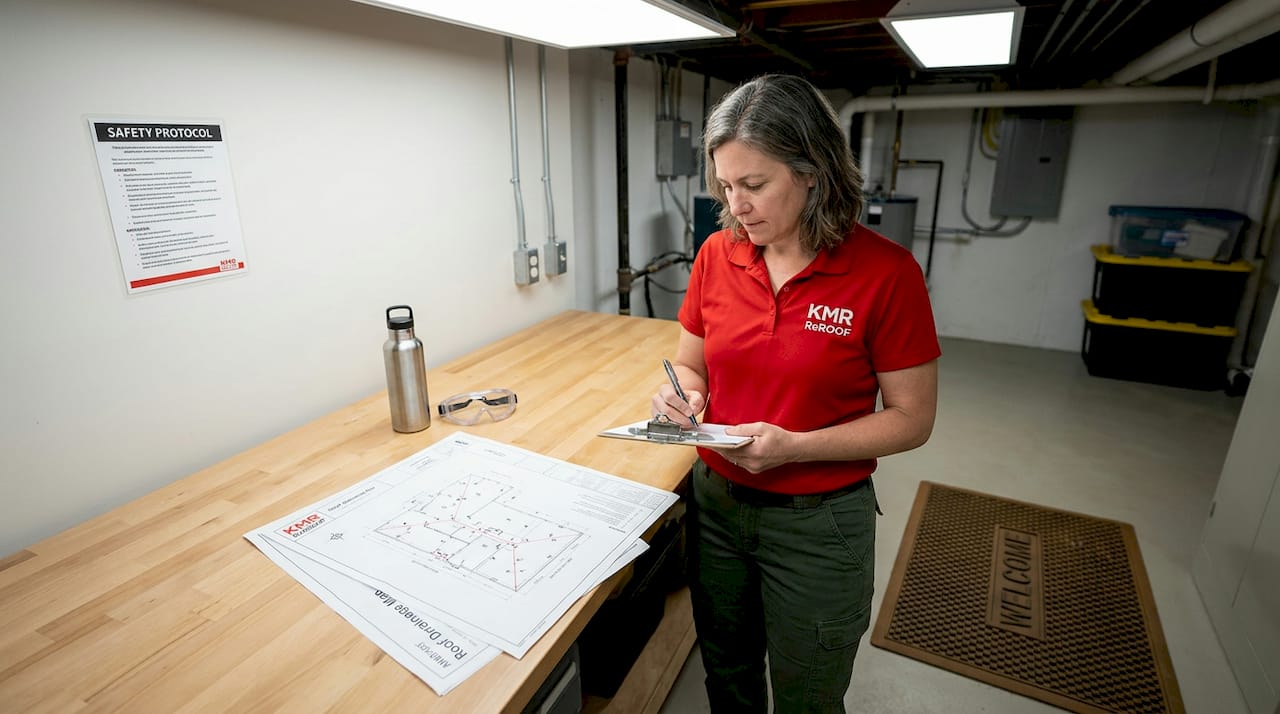
- Use a digital inspection schedule with consistent defect tracking to maintain accountability across staff or contractors.
- Take photos from the same positions on the roof at every inspection so you can track progression of any low spots or drainage slow zones.
- Review your secondary overflow condition at every inspection cycle. Overflows are often last on the list and first to fail silently.
- If your facility has the budget and the roof is large, IoT moisture sensors placed near known low spots give you real-time ponding alerts before 48 hours have passed.
What your monitoring records should trigger:
- Recurring ponding in the same spot after two consecutive inspections: escalate to slope correction
- Drain strainer replaced or cleaned more than three times in one year: investigate root cause (biological growth, HVAC drainage discharge, downhill debris path)
- Membrane discoloration or softness near drains: schedule a Texas roof maintenance check before the condition spreads
Pro Tip: Assign ponding locations on your roof map a “severity rating” of 1 to 3. Rating 1 means it clears within 24 hours and you monitor it. Rating 2 means it clears in 24 to 48 hours and you plan a fix in the next maintenance cycle. Rating 3 means it stays past 48 hours and you get a contractor on-site within the week. This system removes the guesswork from prioritization.
After establishing your verification and monitoring process, here is our perspective on why the workflow approach beats reactive fixes every time.
Expert perspective: Why a proactive workflow beats reactive fixes for Texas flat roofs
After working with flat roofs across El Campo, Houston, and the surrounding Texas Gulf Coast region, the pattern is always the same. The properties that avoid expensive repairs are not the ones with the most sophisticated drainage systems. They are the ones with a written, repeatable inspection routine that actually gets followed.
The most common failure we see is not a design flaw. It is a skipped slope check combined with reliance on a single drain path. When that one drain gets blocked by debris or HVAC displacement, there is nothing backing it up. Water sits. Membrane degrades. By the time the building owner notices a ceiling stain, the damage has been building for months.
Texas amplifies every drainage weakness. The storm intensity on the Gulf Coast can drop two to three inches of rain in under an hour. When that happens, a partially blocked primary drain and a non-functional overflow scupper becomes a structural risk event, not just a maintenance issue. Drainage redundancy is built-in insurance against exactly these scenarios, and relying on primary drains alone is a gamble that Texas weather will eventually win.
What separates effective flat roof water management from expensive reactive repairs is operational repeatability. A workflow that gets documented, assigned to someone accountable, and reviewed after every storm is more valuable than any single premium drain product. The tools are less important than the habit.
One more thing worth saying plainly: small drainage blockages are almost always cheap to fix when caught early. The same blockage left for two seasons can require full membrane replacement in that section. If you are reading this after discovering a problem, get a professional assessment quickly. If you are reading this as a preventive measure, you are already ahead of most property managers in the state.
For properties that want to ensure their roofs meet current drainage and slope requirements, reviewing Texas roofing codes and compliance is a practical next step.
Professional flat roof drainage solutions and maintenance in Texas
If your flat roof’s drainage workflow needs a professional review, upgrade, or a full replacement to correct slope and system deficiencies, Mister ReRoof handles all of it across El Campo and Houston, TX.

We assess existing drainage conditions, install or retrofit tapered insulation where slope correction is needed, and set up both primary and secondary drainage systems built to Texas building code. Our scheduled maintenance plans include bi-annual inspections and post-storm checks so nothing falls through the cracks. Whether you need a flat roof replacement in El Campo or are considering TPO roofing for improved membrane durability and drainage performance, our team brings the same attention to detail to every job. Contact Mister ReRoof today for a free estimate and let us build a drainage solution that protects your property for the long term.
Frequently asked questions
What is the recommended minimum slope for effective flat roof drainage?
The minimum recommended slope for flat roofs is 1/4 inch per foot, achieved through a sloped deck or tapered insulation, to ensure positive drainage toward drains and scuppers.
How often should flat roof drains be inspected and cleaned?
Flat roof drains should be cleaned at least twice annually under standard maintenance protocols, plus after any storm that delivers significant rainfall.
Why is secondary overflow drainage important for flat roofs?
Secondary overflow drainage acts as a backup when primary drains are blocked or overwhelmed, and codes require it as a fail-safe to prevent dangerous ponding and structural risk.
What defines ponding water that needs urgent attention?
Ponding is water lasting 48 hours or more after rain stops, signaling a drainage deficiency or membrane problem that requires assessment and remediation.
Can tapered insulation retrofit solve drainage problems on flat roofs?
Yes, tapered insulation is one of the most effective fixes for slope deficiencies. Retrofits using tapered insulation correct existing deck slope problems and restore positive drainage without a full structural overhaul.