TL;DR:
- Texas industrial roofs last 15 to 20 years due to extreme weather conditions.
- Hail, wind, UV, and thermal cycling cause latent damage leading to early failure.
- Regular inspections and documentation help prevent costly repairs and aid timely repairs or replacement.
Texas industrial roofs face a punishment that roofs in most other states simply don’t. Between relentless UV exposure, violent hailstorms, and wild temperature swings, Texas roofs last just 15 to 20 years compared to 25 to 30 years nationally. That gap translates directly into unplanned downtime, expensive emergency repairs, and insurance headaches. For property managers and business owners running facilities across the state, understanding the most common industrial roof problems isn’t just helpful knowledge. It’s the difference between a manageable maintenance budget and a six-figure crisis that shuts operations down.
Table of Contents
- Recognize the top industrial roof problems in Texas
- Texas weather’s impact: Why local roofs fail faster
- Diagnosing damage: Seams, fasteners, drainage and hidden issues
- Repair or replace? Making smart, cost-effective decisions
- What most guides miss: Prevention and documentation are your superpowers
- Professional solutions for every Texas industrial roof need
- Frequently asked questions
Key Takeaways
| Point | Details |
|---|---|
| Texas roofs fail faster | Regional weather shortens roof life and demands extra maintenance for industrial buildings. |
| Detect problems early | Latent storm damage and thermal fatigue can be spotted with inspections and scanning. |
| Repair vs replacement | If more than 30% is damaged, replacement is typically more cost-effective than piecemeal repairs. |
| Prevention pays off | Budgeting for annual maintenance dramatically reduces expensive emergency repairs. |
Recognize the top industrial roof problems in Texas
Now that you know why Texas roofs are at risk, let’s detail the specific problems to watch for. The variety of threats to industrial roofs here is broader than most property managers expect. Some are dramatic and obvious. Others are silent killers that don’t reveal themselves until a ceiling tile collapses or a warehouse inventory gets soaked.
The most common commercial roof problems in Texas fall into these categories:
- Hail damage and micro-punctures: Texas sees hundreds of significant hail events every year. The tricky part is that hail causes latent damage like micro-punctures and seam splits that may not leak for months. By the time water appears inside, the membrane beneath has often been compromised across a wide area.
- Wind uplift at edges and corners: High-wind events, particularly in open industrial zones, create enormous pressure differentials at roof edges. Fasteners work loose, perimeter flashings lift, and the entire edge detail becomes a water entry point.
- UV membrane degradation: Prolonged sun exposure breaks down the polymers in roofing membranes. TPO, EPDM, and modified bitumen all suffer surface cracking and brittleness over time. Once the surface layer degrades, the waterproofing layer below is exposed.
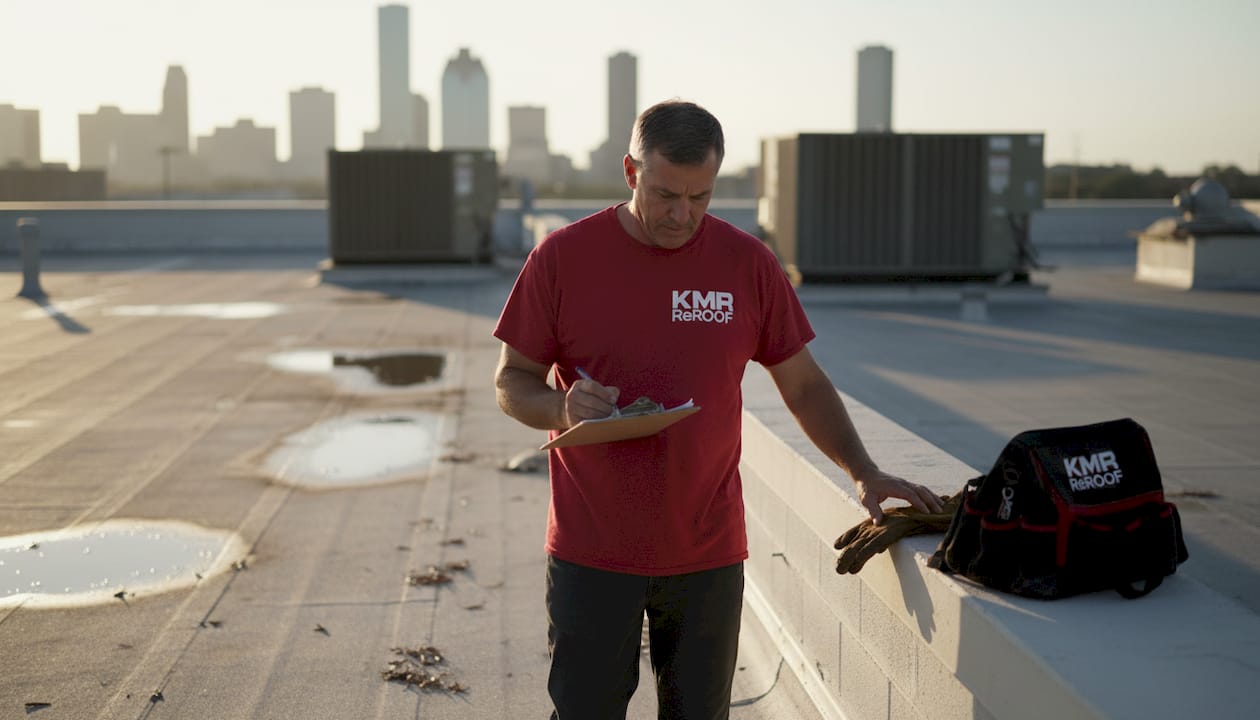
- Ponding water: Flat and low-slope industrial roofs are especially vulnerable. Standing water accelerates membrane deterioration, adds structural load, and creates the perfect environment for algae and root intrusion.
- Loose seams and fasteners: Thermal cycling, the constant expansion and contraction caused by Texas temperature swings, works seams apart over time. This is one of the top reasons roofs fail well before their projected lifespan.
It’s worth noting that TPO now accounts for more than 50% of new commercial installs nationally, but it remains one of the more hail-susceptible single-ply options. Metal roofs handle wind and fire exceptionally well but are prone to fastener corrosion and thermal expansion issues. Flat built-up roofs resist ponding better when properly sloped but suffer when drainage systems fail.
“The most expensive damage is the damage you don’t see. A micro-puncture from hail can sit dormant for two seasons before it costs you more than the original repair would have.”
Pro Tip: Don’t wait for an active leak to signal a problem. Use a hail damage checklist within 72 hours of any significant storm to look for subtle surface bruising, displaced granules, and edge distortion before moisture has a chance to migrate inward.
If you’re unsure where to start when evaluating your roof’s condition, reviewing the most frequent reasons roofs fail in Texas gives you a strong diagnostic framework before calling in a professional.
Texas weather’s impact: Why local roofs fail faster
With these problems identified, it’s crucial to understand why Texas roofs deteriorate so quickly compared to the national average. The simple answer is that Texas weather attacks roofs from multiple directions simultaneously, and the combination of stressors is far more destructive than any single factor alone.
UV exposure in Texas is intense and relentless. The state averages 220 to 240 sunny days per year in many regions. UV radiation doesn’t just fade colors. It breaks down molecular bonds in roofing membranes, causing them to lose elasticity and crack. Once cracking begins, water infiltration accelerates dramatically.
Thermal swings are equally brutal. A Texas roof surface can hit 170°F in summer and drop to near freezing in winter. That’s a temperature range of more than 150 degrees that the membrane must accommodate without splitting or separating. Over years of cycling, this stress fatigue is a primary driver of seam and fastener failure.
Hail volume is staggering. In 2022 alone, Texas recorded more than 700 hail storms, making it one of the most storm-battered states in the country. Each event deposits impact stress across the entire roof surface, often without creating immediately visible damage.
Freeze-thaw cycles in North and Central Texas add another layer of wear. Water that infiltrates minor cracks or seam gaps freezes, expands, and pries the defect wider. Repeated over a winter season, a hairline crack becomes a structural gap.
HVAC vibration from large rooftop units is an underappreciated contributor. The constant mechanical vibration transmitted through penetrations and curb flashings gradually loosens seals and gaskets, creating water entry points that look unrelated to weather damage.
| Factor | Texas impact | National average |
|---|---|---|
| Avg. roof lifespan | 15 to 20 years | 25 to 30 years |
| Annual hail events | 700+ (2022 data) | Significantly lower |
| Peak surface temperature | Up to 170°F | Up to 140°F |
| UV intensity index | High to very high | Moderate to high |
| Freeze-thaw cycles | Variable, increasing | More predictable |
Following a complete Texas roofing inspection checklist twice yearly accounts for both storm aftermath and slow environmental degradation. As 2026 roofing trends in Texas show, forward-thinking property managers are shifting to reflective and impact-resistant materials specifically engineered for these conditions.
Pro Tip: Scheduling your inspections in spring and fall, rather than summer and winter, gives you the best visibility into seasonal damage and lets you address issues before the most extreme weather arrives.
Diagnosing damage: Seams, fasteners, drainage and hidden issues
Understanding what’s accelerating damage, let’s focus on how to pinpoint hidden issues before they become disasters. Knowing where roofs fail is only half the battle. You also need to know how to find the damage before water does it for you.
The critical weak spots on any industrial roof are fairly consistent:
- Seams and overlaps: This is where most leaks originate. Seam adhesive degrades, heat-welded seams delaminate, and lapped sections peel under wind stress.
- Fastener heads: Over time, Texas thermal cycling fatigues seams and fasteners, backing them out slightly and breaking the seal beneath the fastener plate.
- Drainage points and gutters: Clogged or slow drains allow water to pond and work under membrane edges. Regular drain maintenance prevents one of the most avoidable causes of roof failure.
- HVAC penetrations and curb flashings: Mechanical vibration and thermal movement stress the sealant around every rooftop penetration. These spots need sealant inspection every single season.
- Parapet walls and copings: The intersection of a vertical wall and a horizontal roof is inherently complex. Water pools here, flashing pulls away, and block cracks admit moisture that migrates down into the structure.
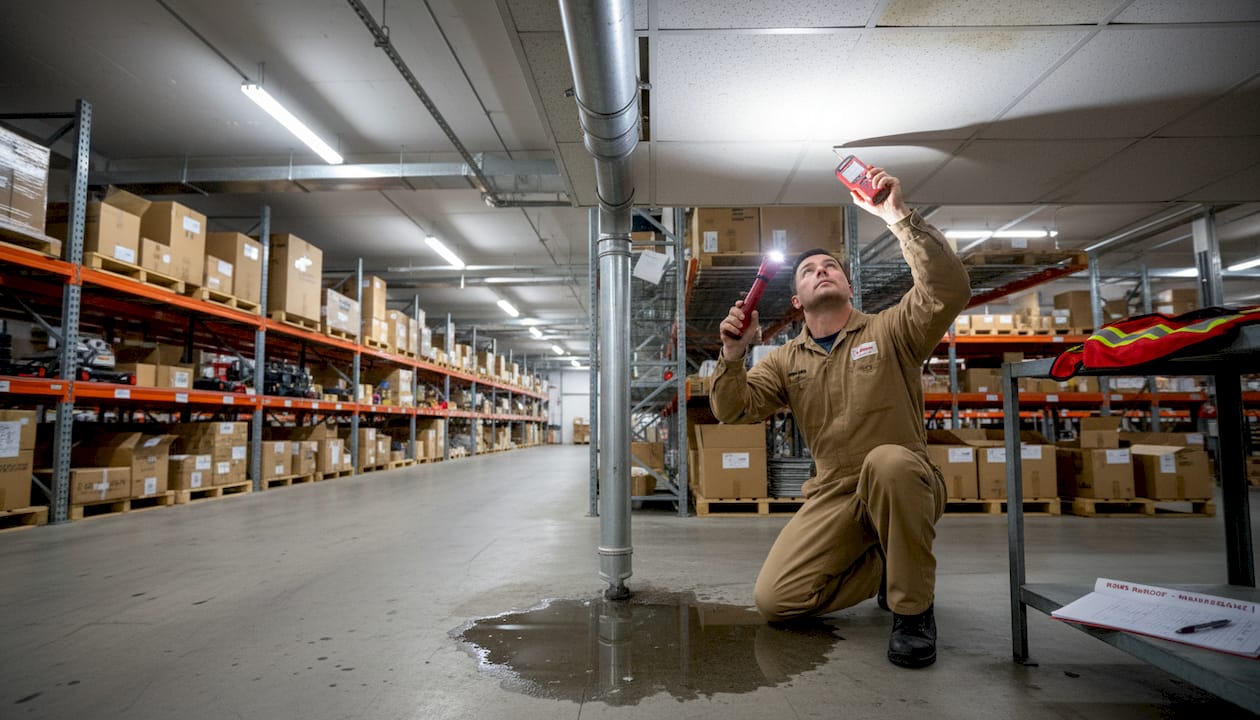
The diagnostic approach has evolved significantly. Visual inspection from the roof surface catches obvious issues, but a lot of the most costly damage is invisible to the naked eye.
| Detection method | What it finds | Limitations |
|---|---|---|
| Visual inspection | Surface cracking, obvious seam gaps, visible ponding | Misses subsurface moisture, early micro-punctures |
| Infrared thermal scan | Wet insulation beneath membrane, hidden moisture pathways | Requires temperature differential, weather-dependent |
| Electronic leak detection | Exact pinpoint of membrane breach | Requires specialist equipment and trained operator |
| Core sampling | Insulation saturation level, membrane adhesion | Destructive, limited sample points |
Infrared and moisture scanning have become the gold standard for pre-purchase assessments and post-storm evaluations. These tools detect trapped moisture in the insulation layer before it migrates to interior spaces, giving property managers the ability to address a 50-square-foot problem before it becomes a 5,000-square-foot replacement zone.
Following safe roof inspection steps is essential before attempting any self-inspection on industrial roofs. Wet membranes are slippery, HVAC units create electrical hazards, and edge conditions on large flat roofs present real fall risks.
Repair or replace? Making smart, cost-effective decisions
Once issues are found, Texas property owners face a critical decision: repair or replace? Here’s how to get it right. Getting this call wrong in either direction is expensive. Over-repairing a roof that needs replacement burns money on a system with no remaining life. Replacing a roof that needed only targeted repairs wastes capital that could fund other building improvements.
Here’s a structured way to make the decision:
- Assess total affected area. If more than 30% of the roof surface is compromised or contains saturated insulation, replacement becomes the more cost-effective long-term choice. Patching a roof at that damage level is like putting new tires on a vehicle with a blown engine.
- Calculate age vs. remaining lifespan. A roof at 80% of its expected lifespan with moderate damage is a replacement candidate. A roof at 40% of its expected lifespan with localized damage is a strong repair candidate.
- Review your warranty. Many manufacturer warranties become void when third-party patches are applied, or when maintenance records can’t be produced. Check your terms before scheduling repairs.
- Get a full cost comparison. Annual roofing maintenance costs run $0.15 to $0.25 per square foot. Emergency repairs without maintenance history run $2.00 to $5.00 per square foot. Over a 10-year period, the math strongly favors proactive spending.
- Factor in operational disruption. A full replacement completed in a planned window costs far less in business disruption than repeated emergency repairs that shut down operations unpredictably.
Understanding a complete industrial roof replacement process helps you plan the project timeline, coordinate with tenants or operations teams, and set realistic budget expectations well in advance. If you’re evaluating a full system overhaul, reviewing commercial re-roofing basics clarifies whether tear-off or overlay is appropriate for your specific structure.
For a broader view of how repair decisions affect property value over time, boost property value with maintenance provides relevant context on long-term return. A repair vs. replacement overview can also frame the financial logic in a way that’s easy to present to stakeholders or ownership groups.
Pro Tip: Document every inspection, repair, and contractor visit with photos and written reports. When an insurance claim or warranty dispute arises, those records are the single most powerful tool you have. Claims without documentation are routinely denied or underpaid.
Understanding when to replace commercial roofs before conditions become critical gives you the scheduling flexibility to choose materials, contractors, and timing rather than scrambling under pressure.
What most guides miss: Prevention and documentation are your superpowers
Most articles about industrial roofing focus on what went wrong and how to fix it. That’s useful, but it misses the strategic advantage that separates good property managers from great ones. The real edge isn’t in how fast you respond to damage. It’s in how rarely you have to respond at all.
We’ve seen this pattern consistently: property managers who maintain detailed inspection records, even simple dated photos and contractor notes, win insurance claims faster, preserve manufacturer warranties longer, and catch problems at a stage where a $400 sealant repair prevents a $40,000 deck replacement.
Budgeting just $0.15 to $0.25 per square foot annually for maintenance feels like overhead until you compare it to a $3.00 per square foot emergency repair on 20,000 square feet. At that point, skipping maintenance looks exactly like what it is: a false economy.
The documentation habit also changes how you interact with contractors. When you walk into a bid meeting with three years of inspection photos and a maintenance log, you control the conversation. Contractors who might otherwise recommend full replacement on a repairable roof know you have the data to push back.
Following a consistent roof inspection checklist twice yearly isn’t bureaucratic overhead. It’s the most financially productive 90 minutes you can spend on your property each season.
Professional solutions for every Texas industrial roof need
For Texas property managers ready to take action, expert help is just a click away. When your inspection reveals damage that goes beyond a DIY patch, or when your roof has reached the end of its serviceable life, working with a contractor who specializes in Texas industrial systems makes a significant difference in both outcome and total cost.
Mister ReRoof serves property managers and business owners across the Texas Gulf Coast region with full-service replacement for metal roofing, flat roofing, TPO systems, and shingle systems. Whether you need metal roof replacement in Victoria, flat roof specialists in El Campo, or TPO roof solutions in El Campo, the team is equipped to handle the full scope of your project. Contact Mister ReRoof today for a free estimate and a team that understands exactly what Texas weather demands.
Frequently asked questions
How often should industrial roofs be inspected in Texas?
Twice a year is the standard recommendation given Texas storm frequency and extreme seasonal weather. Consistent inspections cut emergency costs by 60 to 70% over time.
What are the first signs of hail damage on industrial roofs?
Look for small surface punctures, granule displacement, and seam splits within days of a storm. Because hail creates latent micro-punctures, waiting for interior leaks to confirm damage means the membrane has already failed across a wider zone.
How can I tell if repair or replacement is more cost-effective?
If more than 30% of your roof area is compromised, replacement typically wins on total cost. When more than 30% is affected, patching rarely holds long enough to justify the expense.
What is the typical lifespan of a Texas commercial roof?
Most commercial roofs in Texas last 15 to 20 years due to UV intensity, hail volume, and thermal cycling, well short of the 25 to 30 year national average.
Are some roofing materials better for Texas storms?
Metal roofs and silicone coatings generally outperform standard TPO in high-hail environments. Single-ply TPO dominates installs nationally but carries higher hail vulnerability, while metal handles wind and impact well despite thermal expansion considerations.