TL;DR:
- Choosing the correct flat roof installation method is critical for Texas properties to withstand high winds, UV exposure, and heavy rain. Proper drainage, edge, and penetration waterproofing are essential to prevent failures and protect warranties. Contractor adherence to manufacturer guidelines ensures long-term performance, especially in storm-prone Texas conditions.
Choosing the wrong flat roof installation method in Texas is not just a budget mistake. It is a structural risk. The top flat roof installation methods differ significantly in how they handle wind uplift, UV exposure, and the kind of heavy rain that rolls through the Gulf Coast region without warning. Get the method right, and your roof performs quietly for decades. Get it wrong, and you are looking at membrane billowing, seam failures, and interior water damage after the first major storm. This guide breaks down every major method with the criteria, comparisons, and recommendations you need to make a confident decision.
Table of Contents
- Key criteria for selecting a flat roof installation method
- Overview of top flat roof installation methods
- Detailed breakdown: Installing TPO and other single-ply systems
- Comparing installation methods: Performance, cost, and resilience
- Choosing the right installation method for your Texas property
- What most property owners get wrong about flat roof installations
- Protect your investment with expert roof installation in Texas
- Frequently asked questions
Key Takeaways
| Point | Details |
|---|---|
| Weather drives method choice | Pick installation methods that match your Texas property’s unique climate risks for lasting results. |
| Drainage and details matter | Ensuring proper slope and professionally installed edges is essential to preventing leaks. |
| Follow manuals for warranties | Comply with manufacturer guidelines during installation to keep warranty protection valid. |
| Consider installation tradeoffs | Mechanical, adhered, welded, and ballasted systems each offer different benefits and costs. |
| Expert help pays off | Choosing qualified installers ensures system performance and long-term peace of mind. |
Key criteria for selecting a flat roof installation method
Texas is not a forgiving climate for roofs. You are dealing with intense summer heat, coastal humidity, high-wind events, and hailstorms that can arrive in any season. Before you compare flat roof techniques, you need to know what standards your chosen method must actually meet.
Weather exposure comes first. A flat roof in Houston or El Campo faces sustained wind speeds and UV intensity that would shorten the life of any system installed without those conditions in mind. The drainage design and assembly continuity of your roof determine its long-term performance more than any single material choice.
Drainage is non-negotiable. Flat roofs are not truly flat. They require a minimum slope, typically 1/4 inch per foot, to move water toward drains or scuppers. Ponding water is the silent killer of flat roofs. It adds weight, degrades membrane adhesives, and creates freeze-thaw stress in the rare Texas cold snaps.
Here are the core factors that should shape your method selection:
- Wind uplift rating required by local building codes
- Roof deck type (steel, concrete, wood) and its compatibility with fastening systems
- Whether the building is occupied (noise and fumes during installation matter)
- Budget range and expected service life
- Warranty requirements from your insurer or lender
Edge and penetration waterproofing deserve special attention. These are the areas where most flat roof failures begin, and manufacturer edge guidelines require compliance with recognized industry standards such as SMACNA and NRCA specifications to maintain warranty coverage.
“The quality of a flat roof installation is ultimately determined by how well the drainage is designed and how consistently the assembly is executed from field to edge.”
Pro Tip: Before signing any flat roof contract, ask your contractor to show you the specific manufacturer application guide they will follow. If they cannot produce it, that is a red flag worth taking seriously. You can also review a flat roofing solutions comparison to understand how different systems stack up before your first contractor conversation.
A thorough flat roof inspection guide can also help you assess your current roof’s condition before deciding on a replacement method. And if water resistance is your primary concern, understanding waterproofing flat roofs in a Texas context will sharpen your expectations.
Overview of top flat roof installation methods
Now that you know what to look for, here is a breakdown of the major flat roof installation techniques used for Texas properties. There are four primary attachment methods for single-ply membranes: mechanical fastening, fully adhered, induction-welded, and ballasted. Hybrid assemblies are also possible when a single method does not meet all project requirements.
| Method | How it works | Best for |
|---|---|---|
| Mechanically fastened | Membrane screwed through insulation to deck | Moderate wind zones, budget-conscious projects |
| Fully adhered | Membrane glued directly to insulation | High-wind areas, occupied buildings |
| Induction-welded | Special plates welded through membrane using electromagnetic tool | High-wind zones, no visible hardware |
| Ballasted | Membrane held down by gravel or pavers | Low-slope roofs with structural capacity |
| Hybrid | Combination of above methods | Complex roofs with varied risk zones |
Mechanically fastened systems are the most common starting point for commercial flat roof construction methods. They install faster than adhered systems and cost less in labor. The tradeoff is that the fasteners create points where the membrane can flutter under wind pressure, which increases stress on seams over time.
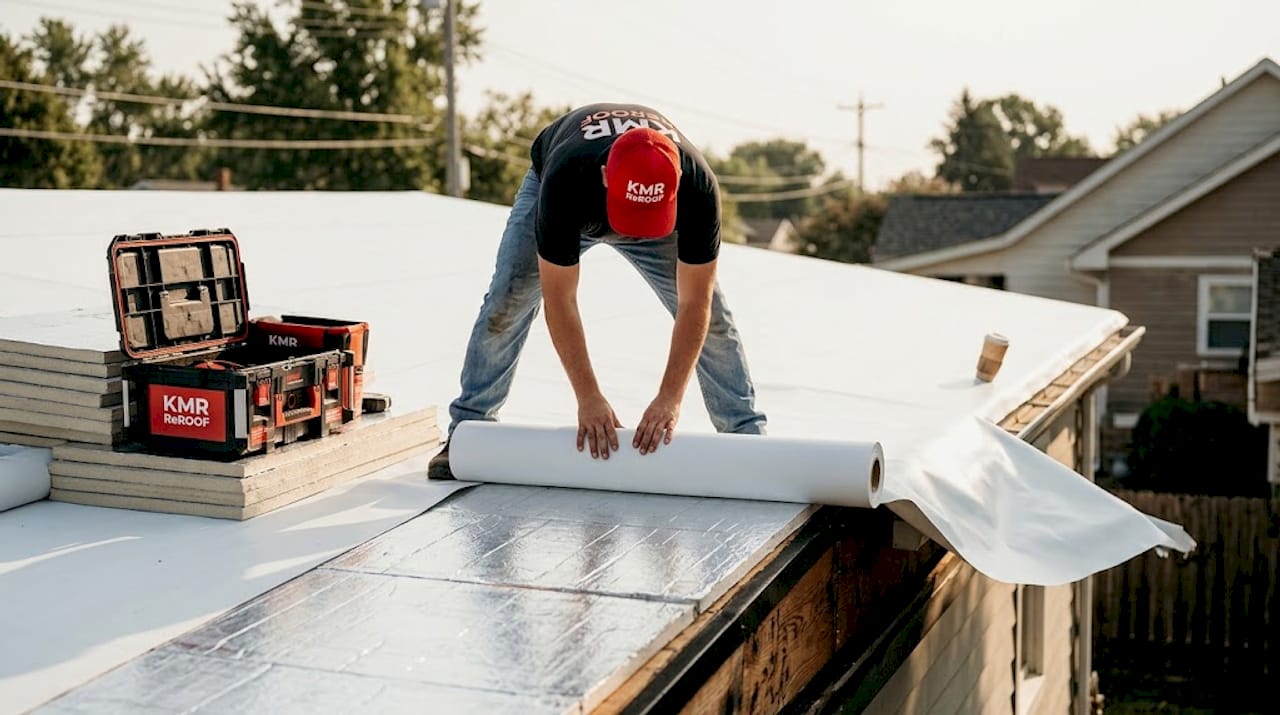
Fully adhered systems bond the membrane directly to the insulation layer, eliminating that flutter entirely. This makes them the preferred choice for occupied buildings where noise is a concern and for properties in high-wind corridors. The adhesive process takes longer and requires careful surface preparation, but the result is a quieter, tighter assembly.
Induction-welded systems are the most technically advanced of the group. A specialized tool uses electromagnetic energy to weld the membrane to plates that are fastened below it. No hardware is visible from the surface, and the wind resistance is excellent. This method is gaining ground in commercial flat roof solutions across Texas’s storm-prone regions.
Ballasted systems use the weight of river rock or concrete pavers to hold the membrane in place. Installation is fast, but the added load requires a structurally capable deck. Warranty options are more limited, and this method is rarely the right fit for residential flat roof systems or older buildings.
For a closer look at how these translate to real-world conditions, the durable flat roofing options available in the Houston area give you a practical regional perspective.
Detailed breakdown: Installing TPO and other single-ply systems
With an overview of methods in place, let’s look at how one of the most widely used systems, TPO single-ply, is actually installed on a Texas property. TPO (thermoplastic polyolefin) is popular because it reflects UV radiation, resists punctures, and welds cleanly at seams. But its performance depends entirely on execution.
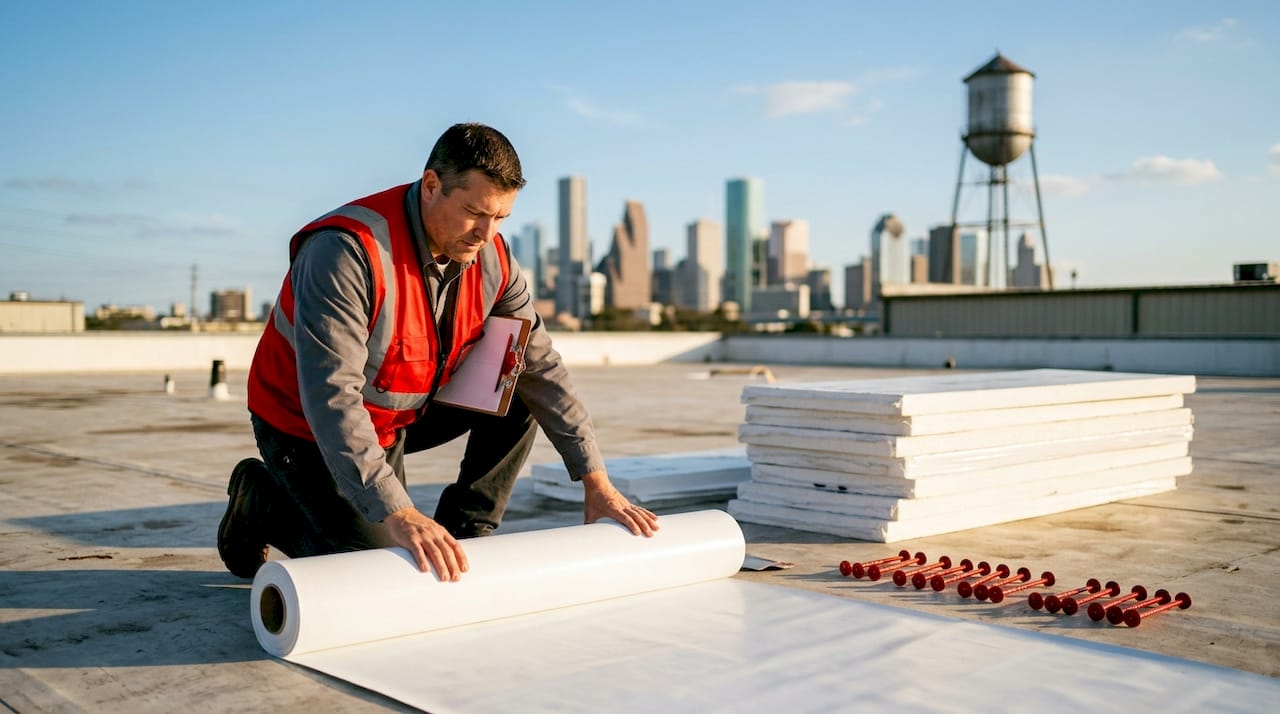
A proper TPO installation follows a documented sequence that should not be shortcut:
- Prepare the drain area first. Drains must be set at the correct elevation and cleared of debris before any membrane goes down. This is the lowest point of the roof and the most consequential.
- Install insulation boards. These are fastened to the deck in a staggered pattern to eliminate thermal bridging. Board edges must be tight to prevent membrane bridging later.
- Roll out the TPO membrane. Rolls are oriented perpendicular to the slope and allowed to relax before fastening. Rushing this step causes wrinkles that trap water.
- Apply fasteners and plates. In a mechanically fastened system, fasteners run along the membrane edge at specified intervals. The pattern is not arbitrary. It is calculated based on wind zone and deck type.
- Weld all seams. A hot-air welder fuses overlapping membrane edges into a single watertight bond. Seam width, temperature, and speed all affect weld quality. A probe test confirms every weld.
- Install “fingers” at seams. Small cuts at the seam overlap edge reduce stress concentration and lower the risk of uplift at corners.
- Flash all edges and penetrations. This step is where most failures originate. Pipe boots, curb flashings, and perimeter edge metal must all be installed to manufacturer and NRCA specifications.
“Seam welding and flashing work are not finishing touches. They are the primary waterproofing tasks on any single-ply flat roof.”
Pro Tip: Ask your contractor for a seam probe test report after installation. A reputable crew will test every weld and document the results. This record also supports your warranty claim if a seam ever fails.
For a more detailed walkthrough, the TPO roof installation step guide covers each phase with the specificity that Texas property owners need.
Comparing installation methods: Performance, cost, and resilience
After describing the main systems, it is time to see how they stack up for real decisions. Here is a side-by-side comparison across the factors that matter most to Texas property owners.
| Method | Upfront cost | Install speed | Wind uplift resistance | Warranty options | Best climate fit |
|---|---|---|---|---|---|
| Mechanically fastened | Low | Fast | Moderate | Standard | Moderate wind zones |
| Fully adhered | Medium-high | Moderate | High | Extended available | High-wind, coastal |
| Induction-welded | High | Moderate | Very high | Extended available | Storm-prone Texas regions |
| Ballasted | Low-medium | Fast | Low-moderate | Limited | Low-risk, heavy-deck only |
The data is clear on one point: induction-welded and adhered membranes perform best in high-wind areas because they eliminate the membrane movement that fatigues seams over time. In a mechanically fastened system, the membrane can flex between fastener rows under wind pressure. That flexing is not immediately catastrophic, but it compounds with every storm cycle.
For Texas properties along the Gulf Coast or in open rural areas with minimal wind breaks, the cost difference between mechanical and adhered installation is often recovered within a few years through avoided repairs. A ballasted system might look attractive on paper, but the structural requirements and limited warranty coverage make it a poor fit for most residential flat roof systems and light commercial buildings in this region.
The durable flat roofing options for Texas available today have improved significantly, and the gap between mechanical and adhered systems in terms of installed cost has narrowed as adhesive technology has advanced.
Choosing the right installation method for your Texas property
With the comparisons in mind, here is how to decide what works best for your specific building and climate exposure.
For commercial and light-industrial properties in storm-exposed areas, adhered or induction-welded systems are the right call. The higher upfront cost is justified by better wind performance, quieter operation during occupied hours, and access to extended manufacturer warranties.
For multifamily residential flat roof systems or occupied buildings, fully adhered installation eliminates the noise and disruption of fastener-driven systems and provides a cleaner finished appearance at parapets and edges.
For moderate-risk properties with tight budgets, mechanically fastened systems can perform well when the fastener pattern is designed for the local wind zone and the seam welding is executed properly. The key is not cutting corners on the fastener schedule.
Here is what to require from any contractor you hire:
- Written confirmation that they will follow the specific manufacturer application guide
- Documentation of the fastener pattern and seam weld tests
- Proof that edge and flashing work meets SMACNA or NRCA standards
- A warranty certificate issued directly by the manufacturer, not just the contractor
Manufacturer manual compliance is not optional if you want a valid warranty. This is especially important in Texas, where wind and storm events will test every detail of the installation within the first few years.
Pro Tip: Do not treat edge and flashing work as a minor finishing step. Walk the perimeter of the completed roof yourself and compare what you see against the manufacturer’s flashing detail drawings. Discrepancies at the edge are the most common source of warranty disputes and early failures.
Additional resources worth reviewing before you commit: smart flat roof design ideas for Houston properties, storm-resistant roofing methods specific to Texas, and a clear explanation of why roof warranties matter for long-term financial protection.
What most property owners get wrong about flat roof installations
Here is the uncomfortable truth after years of seeing flat roof projects succeed and fail across Texas: most problems are not caused by choosing the wrong membrane material. They are caused by undervaluing the details that every installation guide covers in the first ten pages.
Edge conditions and penetrations are where the highest-risk failures occur. A perfectly welded field membrane means nothing if the perimeter edge metal is installed without the correct sealant and overlap. Water does not care how good the middle of your roof looks. It finds the one gap at a pipe boot or a parapet corner and works inward from there.
The second mistake is letting upfront cost drive method selection without accounting for the wind risk profile of the property. A mechanically fastened system that saves $8,000 on a 10,000-square-foot roof can cost far more than that in repairs after a single Gulf Coast storm event. The math only works if the installation method matches the actual risk.
The third mistake is treating the manufacturer’s application guide as bureaucratic paperwork. It is not. It is the document that defines what the warranty covers and what voids it. When a contractor says they will “follow standard practice,” ask them to show you which standard. If the answer is vague, the warranty is at risk before the first roll of membrane hits the deck.
Proper documentation, including photos of fastener patterns, seam test records, and flashing details, is your evidence if a warranty claim ever becomes necessary. A contractor who resists documenting their work is telling you something important about their confidence in it. For deeper context on why this matters in Texas specifically, the guide on how to waterproof flat roofs covers the waterproofing layer in detail.
Protect your investment with expert roof installation in Texas
Texas weather does not give flat roofs a grace period. When a storm rolls in from the Gulf, every seam, every flashing detail, and every fastener gets tested at once. Choosing the right installation method is only half the equation. The other half is having a contractor who follows the manual, documents their work, and backs it with a manufacturer-issued warranty.

At Mister ReRoof, we install flat and TPO roofing systems built specifically for Texas conditions, from the Gulf Coast to the inland plains. Our TPO roof replacement in El Campo and flat roof replacement service follow manufacturer application guides to the letter, so your warranty is real and your roof is ready for whatever Texas throws at it. Contact us today for a free estimate and a straight conversation about what your property actually needs.
Frequently asked questions
Which flat roof installation method is most resistant to high winds in Texas?
Adhered and induction-welded single-ply membrane systems offer the best resistance to wind uplift common in Texas, because they eliminate membrane movement between fastener points. High-wind performance favors these two methods above all others.
What is the biggest point of failure for flat roofs?
Seams, penetrations, and perimeter edges account for the majority of flat roof leaks and performance failures. The highest-risk points are almost always at transitions, not in the middle of the membrane field.
Can using the wrong installation method void my roof warranty?
Yes, not following the manufacturer’s application guide can invalidate both standard and extended warranties. Warranty coverage requires full compliance with system-specific installation requirements, including edge and flashing details.
How important is drainage in flat roof installation?
Proper drainage design is one of the most critical factors in flat roof longevity, since ponding water accelerates membrane degradation and adds structural load. Flat roofs should drain to a minimum slope with overflow provisions to handle heavy rainfall events.
Can I combine different flat roof installation methods?
Yes, hybrid assemblies are used when a single method does not meet all the demands of a complex project. Hybrid approaches balance cost, wind resistance, and site-specific conditions by applying different attachment strategies to different zones of the same roof.