TL;DR:
- Built-up roofing (BUR) is a heavy, multi-layer system suitable for high-traffic or industrial roofs, but it requires longer installation times and higher costs. TPO offers a lightweight, energy-efficient, and faster-to-install alternative ideal for modern low-slope roofs in Texas, with costs ranging from $4 to $11 per square foot. Your choice should consider structural weight capacity, project timeline, energy savings, and regional requirements to ensure a durable, compliant flat roof solution.
If you manage a flat or low-slope roof in Texas and you’re treating BUR and TPO like interchangeable options, you’re likely heading toward a costly mistake. Built-up roofing (BUR) and thermoplastic polyolefin (TPO) are fundamentally different systems with different weights, installation timelines, maintenance demands, and price points. The Texas climate, with its brutal summer heat, Gulf Coast humidity, and powerful storms, makes the gap between these two systems even wider. This article breaks down every key difference so you can make a confident, informed call for your specific property.
Table of Contents
- Understanding built-up and TPO roofing systems
- Installation process and time considerations
- Performance, durability, and maintenance differences
- Cost and energy efficiency: what to expect in Texas
- Which is best for Texas: deciding factors for homeowners and managers
- The real-world choice: what most roofing guides miss
- Expert help: get the right flat roof for your Texas property
- Frequently asked questions
Key Takeaways
| Point | Details |
|---|---|
| System basics | Built-up roofing uses layered bitumen, while TPO is a single lightweight membrane. |
| Installation time | BUR is slower to install and more disruptive than TPO, requiring special crews. |
| Suitability | Choose TPO for most Texas homes and BUR for industrial or extreme rooftop use. |
| Cost and savings | TPO offers better installation value and energy savings for Texas cooling needs. |
| Code compliance matters | Always check structure, drainage, and windstorm certification before deciding. |
Understanding built-up and TPO roofing systems
Let’s start by breaking down what each system really is and how they’re built.
Built-up roofing is one of the oldest commercial roofing systems still in wide use today. It earns its name from the way it’s constructed: multiple alternating layers of hot bitumen (a thick, sticky petroleum byproduct) and reinforcing ply sheets are built up on top of each other, usually three to five layers deep. The final surface is typically a flood coat of bitumen topped with gravel or a mineral cap sheet for protection. The result is a thick, heavy, battle-tested membrane that has protected low-slope commercial roofs for well over a century.
Thermoplastic polyolefin (TPO), on the other hand, is a single-ply membrane. It’s a relatively modern material, developed in the 1990s, made from a blend of polypropylene and ethylene-propylene rubber. TPO sheets are rolled out across the roof deck and seamed together using hot-air welding equipment. The characteristic white or light-gray color of TPO reflects sunlight rather than absorbing it, which is a significant advantage in a state where summer temperatures stay above 95°F for weeks at a time. You can read more about BUR in Texas and explore the specific TPO benefits that apply to Texas properties before deciding.
Here’s a quick breakdown of the core differences:
- Weight: BUR typically weighs 4 to 6 pounds per square foot or more; TPO is much lighter at around 0.5 to 1 pound per square foot
- Installation: BUR requires hot kettles, multiple material layers, skilled laborers, and several days of work; TPO uses hot-air welding and can be completed faster
- Reflectivity: TPO reflects UV rays and heat; BUR gravel surfaces absorb and retain heat
- Cost: BUR carries higher upfront labor and material costs; TPO is generally more budget-friendly to install
- Best use: BUR suits heavy-traffic roofs, mechanical equipment areas, and high-abuse industrial settings; TPO fits most modern flat residential and light commercial roofs
According to BUR installation standards, the BUR process includes roof deck preparation, base sheet application, alternating hot bitumen mopping and ply sheets across three to five layers, a flood coat, and a final surfacing layer. This process requires hot kettles on site, skilled and experienced crews, produces strong odors during application, and commonly takes 7 to 10 days for a mid-size roof.
Pro Tip: Before requesting a BUR quote, contact a structural engineer or your building’s original contractor to confirm your roof deck can handle the added weight. This single step can save you from a structural problem that no membrane will fix.
Installation process and time considerations
After understanding the materials, the next major factor is how each is installed and how long it takes.
The installation gap between BUR and TPO is significant, especially if your property is occupied during the project. Here’s what the typical process looks like for each system:
BUR installation steps:
- Inspect and prepare the existing roof deck, repairing any soft spots or deteriorated wood or concrete
- Apply a base sheet fastened mechanically to the deck
- Heat bitumen in a rooftop or ground-level kettle to 400 to 500°F
- Mop hot bitumen over the base sheet and immediately embed the first ply sheet
- Repeat the bitumen and ply layer process for three to five total plies
- Apply a flood coat of hot bitumen across the final ply
- Broadcast gravel or apply a mineral cap sheet into the flood coat while it’s still hot
- Allow adequate cure time and perform a final inspection
This process, as noted in the BUR installation data, routinely takes 7 to 10 days for a mid-size roof. Hot kettles create strong odors that can affect building occupants, and the process requires multiple skilled workers on site simultaneously.
TPO installation steps:
- Clean and inspect the roof deck or existing membrane surface
- Install insulation boards if required, fastened mechanically or adhered with adhesive
- Roll out TPO membrane sheets across the roof surface
- Position sheets with proper overlap at seams (typically 3 to 6 inches)
- Weld all seams using a hot-air welder set to approximately 1,000°F
- Probe and test all welded seams with a probe tool to confirm full adhesion
- Install flashing details at penetrations, edges, and drains
- Perform a final quality inspection before the crew leaves
The full TPO install steps for a similar-sized roof typically take 1 to 3 days. That’s a massive difference in disruption, cost per hour of labor, and scheduling. For occupied buildings, businesses, or rental properties, shorter installation windows translate directly to less lost income and fewer tenant complaints.
You should also understand that flat vs pitched roofs have very different installation considerations. Flat roofs in Texas require proper drainage design built into the installation plan regardless of which membrane you choose.
Pro Tip: Labor shortages for BUR-qualified crews are real in Texas markets, particularly in Houston and surrounding areas. If you have a strict timeline, TPO will be significantly easier to schedule with experienced crews, often with a shorter wait for project start dates.
Performance, durability, and maintenance differences
Installation is only half the story. Performance and maintenance directly affect your roof’s longevity and value.
BUR has earned its reputation on durability. When properly installed over a sound deck, a BUR system can last 20 to 30 years or longer, and the multiple layers provide genuine redundancy. If one layer develops a small crack or void, the layers beneath it continue doing their job. This is why BUR still makes sense for rooftop mechanical equipment areas, where workers frequently walk the surface, or in industrial settings with heavy foot traffic and airborne debris.
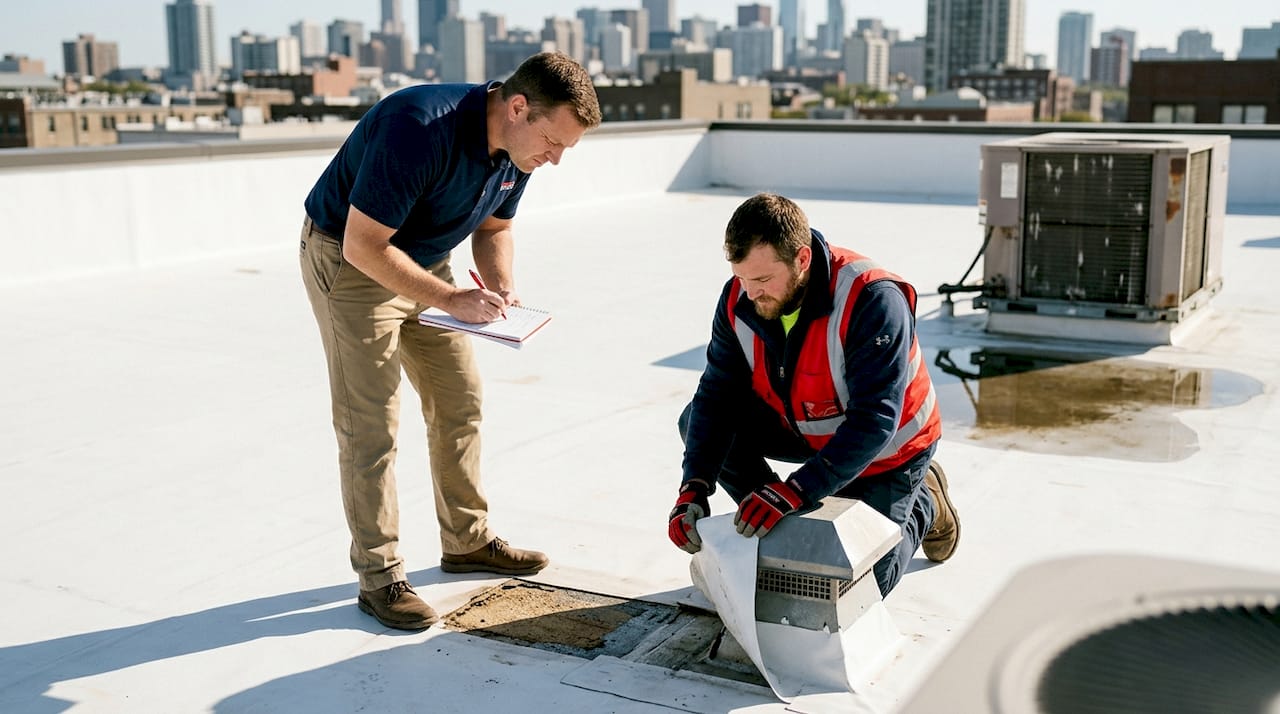
That said, BUR problem areas are worth understanding before you commit. Blisters can form when moisture gets trapped during installation or when poor ventilation causes steam pressure between layers. Standing water is particularly damaging because it softens the bitumen layers over time. The sheer weight of BUR limits your options for adding it as a retrofit over existing systems. And in today’s labor market, qualified BUR crews are harder to find, which can affect repair quality after installation.
TPO’s biggest performance advantage in Texas is solar reflectivity. Its white membrane bounces UV rays back into the atmosphere rather than absorbing them into your building. This keeps your roof surface temperature significantly lower during peak summer heat, which leads directly to lower air conditioning costs. TPO’s main maintenance concern is seam integrity. Heat-welded seams are strong, but improper installation or thermal cycling over many years can cause seam separation. Annual probing of seams is a standard maintenance task for TPO roofs.
Here’s a side-by-side comparison:
| Feature | Built-Up Roofing (BUR) | TPO |
|---|---|---|
| Lifespan | 20 to 30+ years | 15 to 25 years |
| Weight | Heavy (4 to 6+ lbs/sq ft) | Light (0.5 to 1 lb/sq ft) |
| Heat reflectivity | Low (absorbs heat) | High (reflects UV) |
| Foot traffic tolerance | Excellent | Moderate |
| Seam risk | Lower (monolithic layers) | Higher (requires good welds) |
| Maintenance complexity | Moderate to high | Low to moderate |
| Ponding water risk | High | High |
“Good drainage design matters more than membrane type. Both BUR and TPO will fail faster than they should if standing water sits on the surface for more than 48 hours. Proper slope and drain placement are non-negotiable.”
Explore flat roof durability options in depth and review the flat roof benefits that apply to Texas properties. If you’re in the Houston area specifically, there are unique Houston flat roof options worth reviewing before finalizing any decision.
According to RCAT roofing guidelines, Texas property owners should prioritize structural load assessment before BUR installation, design for proper drainage on both systems, verify Texas windstorm certification requirements for coastal properties where TPO with full adhesion is often required, and schedule annual inspections to protect warranty coverage.
Cost and energy efficiency: what to expect in Texas
With durability and maintenance in mind, let’s look at actual costs and ongoing savings you can expect from each system.
Cost is often what drives the initial conversation, but it’s important to look at the full picture rather than just the install quote.
TPO installed cost typically falls between $4 and $11 per square foot depending on project scope. Recover jobs, where TPO is installed directly over an existing membrane without full tear-off, usually run $4 to $7 per square foot. Full tear-off and replacement projects land in the $6 to $11 range based on TPO cost data.
BUR installed cost runs higher due to the labor-intensive installation process, the need for specialized equipment like hot kettles, and the greater quantity of materials used. Depending on the number of plies and surface material specified, BUR projects often cost several dollars more per square foot than comparable TPO work.
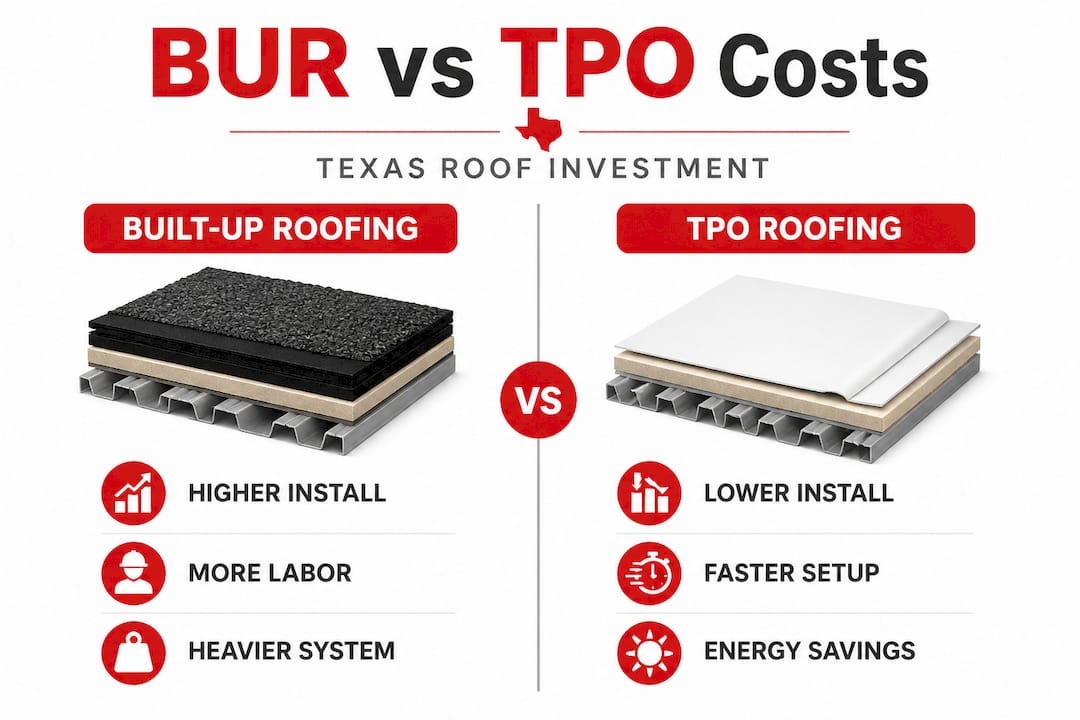
Here’s what the cost comparison looks like at a glance:
| Cost factor | TPO | BUR |
|---|---|---|
| Install cost per sq ft | $4 to $11 | Higher, varies by plies |
| Recover option available | Yes | Rarely |
| Annual cooling savings | Up to $0.30/sq ft | Minimal |
| Repair cost complexity | Low to moderate | Moderate to high |
| Labor availability in Texas | Strong | Limited |
The energy efficiency advantage of TPO deserves special attention for Texas property owners. White TPO membranes can reduce annual cooling costs by up to $0.30 per square foot, which adds up quickly on a 5,000 or 10,000 square foot commercial roof. Over a 15-year roof life, that’s a substantial offset against the installation cost.
You can learn more about specific TPO options that perform well in Texas heat before locking in a material selection with your contractor.
Which is best for Texas: deciding factors for homeowners and managers
With costs and benefits in hand, let’s help you match the right roof option to your specific needs, location, and property type.
Choosing between BUR and TPO is not just about price or personal preference. Several property-specific and regulatory factors will influence the right answer for your situation.
Choose BUR when:
- Your structure has been confirmed to handle the added weight
- You have heavy rooftop foot traffic from maintenance or mechanical equipment access
- Your roof serves an industrial or high-abuse application
- You want a time-tested, multi-layer redundancy approach
Choose TPO when:
- You want lower upfront installation costs and faster project completion
- Energy savings and cooling cost reduction are priorities
- Your property is in a Texas coastal area requiring windstorm certification
- Your structure is residential or light commercial without extreme traffic needs
Texas windstorm insurance requirements, managed through the Texas Department of Insurance for coastal counties, often specify installation methods that favor fully adhered TPO membranes. Texas windstorm certification standards make TPO the more practical choice for many coastal Texas properties.
Understanding how to properly waterproof flat roofs is equally important regardless of which membrane you choose. Waterproofing details at flashings, drains, penetrations, and edges are where most flat roof failures begin, not in the middle of a membrane field.
The real-world choice: what most roofing guides miss
Most BUR vs TPO comparisons lay out the specs and leave you to figure out the rest. Here’s what we actually see in the field that changes real decisions.
The biggest overlooked factor is installer availability. BUR requires experienced crews who know how to operate hot kettles safely, mop bitumen at the right temperature, and embed plies without trapping air or moisture. These crews exist, but in competitive Texas markets, their schedules fill up fast. Property owners who commit to BUR without checking crew availability end up waiting weeks longer than they planned, or worse, accepting a less experienced team just to get the work done on schedule. Poor BUR installation is far more damaging than a delayed start date.
The second thing most guides ignore is the insurance and code equation. Short-term price thinking is common. A lower TPO install quote looks great until you realize your insurance carrier requires a certified windstorm installation, or your local municipality requires a specific installation method based on your roof slope. These factors can completely flip the cost comparison. We’ve seen property owners in Brazoria County, Galveston County, and Harris County discover post-bid that their preferred system didn’t qualify for required wind uplift ratings without a significant upgrade in installation method.
The honest truth is that annual inspections and proper drainage design add more long-term value to any flat roof than the membrane type alone. We’ve seen well-maintained TPO roofs outlast neglected BUR systems by five or more years. A flat roof durability guide will tell you the specs, but the real performance comes from what happens after installation day.
Drainage is the single most important design decision on a flat roof. Get that right, commit to annual inspections, and you’ll extend the life of either system significantly.
Expert help: get the right flat roof for your Texas property
Choosing between BUR and TPO comes down to your structure, your budget, your location, and your long-term maintenance plan. Getting those variables right requires more than an online comparison.
At Mister ReRoof, we specialize in TPO replacement in El Campo and the surrounding region, as well as full flat roof replacement in El Campo for both residential and commercial properties. Our team understands Texas windstorm requirements, structural load considerations, and local climate demands. We give you a straight, honest recommendation based on your actual property, not a one-size-fits-all answer. Contact Mister ReRoof today to schedule a free estimate and get expert guidance tailored to your Texas flat roof project.
Frequently asked questions
Which roof lasts longer: BUR or TPO?
A well-installed BUR can outlast TPO under heavy abuse or high-traffic conditions, but TPO delivers reliable modern performance with simpler repairs and often lower lifecycle costs.
Is TPO roofing more energy efficient than built-up roofing in Texas?
Yes. TPO’s white membrane reflects sunlight and can reduce cooling costs by about $0.30 per square foot each year, making it a strong performer in the Texas heat.
Can my property handle the weight of a built-up roof?
Most residential buildings require a structural load check before BUR installation because BUR is significantly heavier than TPO and can stress roof decks not designed for it.
What’s the installation downtime for each roof type?
BUR installations typically take 7 to 10 days for a mid-size roof, while TPO can usually be completed in 1 to 3 days, causing far less disruption to your property.